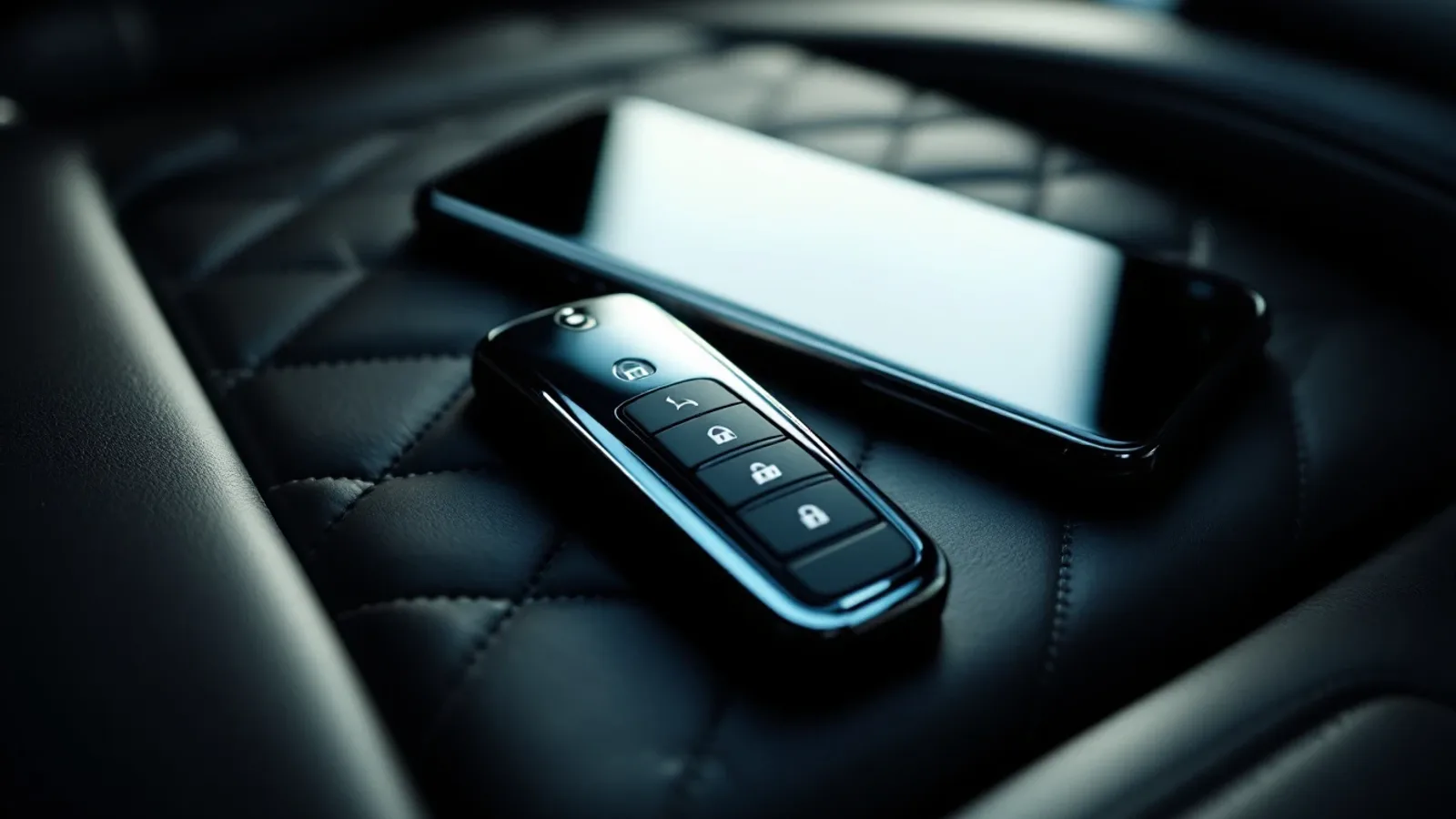
Digital Key vs Physical Key Fob Backup in Frisco, TX: Why EV & Luxury Owners Need Both
2026 advice for Frisco, TX luxury & EV owners: why a phone or digital key still needs a physical fob or card backup, and how to set one up before you need it.
Digital Key vs Physical Key Fob Backup in Frisco, TX
Somewhere in Frisco right now, a beautifully engineered luxury EV is sitting in a parking garage while its owner stares at a dead phone. The car is fine. The battery is charged. The problem is that the only key was in the Apple Wallet on a phone that just went black — and there is no physical fob in the glovebox. It is one of the most avoidable predicaments in modern car ownership, and this article is about making sure it never happens to you.
The digital key — a phone key in Apple Wallet, a Tesla app credential, a BMW Digital Key Plus, a Mercedes me key, a Lincoln or Ford Phone As A Key — is a genuinely great convenience. But convenience and reliability are not the same thing. As of July 2026, our clear, experience-backed advice to every luxury and EV owner in Collin and Denton County is simple: use the digital key for daily convenience, but always keep a physical key or card as your backup. This piece explains exactly why, compares the two credential types honestly, and shows you how to set up a backup before you need it. To arrange a spare, call or text (469) 402-9781 or email contact@friscocarkeys.com.
The core idea: a phone is a single point of failure
Everything in this article flows from one principle. A physical key is a dedicated, single-purpose device that does exactly one thing and does it with no battery of its own to charge, no software to update, and no signal to lose. A phone is a general-purpose device juggling a hundred jobs, any one of which can fail at the worst moment. When your only key rides on a device that can die, crash, get lost, get wet, or get left on a restaurant table, you have quietly created a single point of failure for access to a very expensive car.
Redundancy is not paranoia; it is basic engineering. Aviation, medicine, and data centers all build in backups for exactly this reason. Your car deserves the same thinking — and the backup is cheap.
Digital key vs physical key: an honest comparison
Both credentials have real strengths. The point is not that digital keys are bad — they are excellent — but that the two are complementary, and you want both.
| Factor | Digital key (phone/app) | Physical key/fob/card |
|---|---|---|
| Everyday convenience | Excellent — hands-free, no fob to carry | Good — proximity unlock and push start |
| Depends on battery/charge | Yes — the phone's battery (Express Mode helps briefly) | No — no charge needed on a passive card; fob batteries last years |
| Depends on software/signal | Yes — apps, OS updates, Bluetooth/UWB pairing | No — authenticates directly to the immobilizer |
| Remote revocation if lost | Yes — a real security advantage | No — must reprogram if stolen |
| Sharing with others | Easy, with access levels on some cars | Physical handoff; simple for valet/family |
| Works when handed to a valet | Only if you share a key first | Yes — hand over the fob or a valet key |
| Resale / transfer | Tied to accounts; buyer must re-enroll | Two working keys add value and ease transfer |
| Single point of failure? | Yes, if it's your only credential | No, when kept as a backup |
Read that table and the conclusion writes itself: the digital key wins on convenience and remote control; the physical key wins on reliability, valet use, and resale. Keep both, and you have covered every column.
The failure modes that strand digital-only owners
It helps to name the specific ways a phone-only setup leaves you stuck, because each one is common:
- Dead battery. The most frequent cause. Express Mode buys a small power-reserve window on some phones, but a fully dead phone is a fully dead key.
- Software update. An OS or app update occasionally breaks Wallet or the car's Bluetooth/UWB pairing until it is re-established.
- Lost, stolen, or damaged phone. If your key went with it, you are locked out until you recover access — and on some ecosystems, that runs through the automaker.
- Phone in for repair. Handing your phone to a repair shop can mean handing over your only key.
- Valet or family driver. A valet stand or a quick errand by a family member is awkward when the only key is your personal phone.
- 12-volt battery quirks on EVs. A weak low-voltage battery can cause odd access behavior that mimics a key fault, adding confusion to an already stressful moment.
Every one of these is neutralized by a single physical key kept somewhere sensible. Our related guides on the Tesla key card and phone key and on keeping a spare smart key for a luxury SUV walk through brand-specific versions of exactly these scenarios.
Why the physical key is inherently more reliable
The physical key's reliability is not marketing — it is built into how car security works. A proximity fob or transponder key authenticates to the vehicle's immobilizer, a security system that prevents the car from starting without an authorized key. That layer is credited across the industry with meaningfully reducing vehicle theft, according to research from the National Highway Traffic Safety Administration and the Insurance Institute for Highway Safety (nhtsa.gov; iihs.org). Digital keys ride on top of this same protected system; they do not replace it. The physical key is the direct, dependable path to that immobilizer — no intermediary app, no battery of its own on a card, no dependency on a phone's health.
There is also the security-planning angle. When a physical key is lost or stolen, a locksmith can reprogram the system so the missing key no longer works — which is exactly the kind of anti-theft key management that responsible providers handle within the National Automotive Service Task Force's Secure Data Release System, the framework that vets locksmiths to obtain secure vehicle data legitimately (nastf.org).
How to set up a physical backup before you need it
The single most valuable action in this article is this: have a spare physical key made while everything is working. An emergency all-keys-lost call always costs more, takes longer, and happens at the worst possible time. A planned spare is fast and inexpensive. Here is how to think about it:
- Decide what kind of backup you want. For most owners, that is a spare proximity smart key that fully duplicates the daily key. For some vehicles, a lower-cost valet or card credential is also worth having.
- Do it before an emergency. With at least one working key present, cutting and programming a spare is standard, efficient work — key duplication or smart key & push-to-start programming, depending on the vehicle.
- Store it smartly. Keep the spare somewhere you can actually reach in an emergency — a home safe, with a trusted family member, or a well-hidden spot — not inside the car it opens.
- Confirm the plan for your model. Luxury and EV credential work varies; some exotic all-keys-lost situations are dealer-only, and some EV phone-key enrollment runs through the car's screen or app. We give you an honest, VIN-specific answer.
Realistic July 2026 frames for the physical side: key duplication and spares run roughly $50–$300 depending on the key type, smart-key programming lands in the $120–$500 band, and a non-destructive lockout is about $75–$200. Luxury, exotic, and EV credential work is quoted after we see the VIN because it genuinely varies — and we never fabricate a dealer dollar figure to make a sale.
"The customers who never call us in a panic are the ones who let us cut a spare on a calm afternoon. Ten minutes and a modest fee then saves a two-hour ordeal later. A phone key is fantastic — just don't let it be the only key that exists." — an automotive locksmith, name withheld by request
Special notes for EV owners
EVs add a couple of wrinkles worth calling out. First, the 12-volt low-voltage battery: even on a fully charged EV, a weak 12-volt system can cause strange access and electronics behavior that looks like a "key" problem. If several systems act up at once, suspect the 12-volt battery — and know that this is often a manufacturer service matter, not a locksmith one. Second, enrollment boundaries: on some EVs, adding or managing the digital credential happens through the car's touchscreen or the automaker's app, tied to your account — not through a locksmith's tool. That is exactly why a physical backup key matters so much on EVs: it is the credential that does not depend on any of that. Being honest about these limits is part of doing the job right, and the Federal Trade Commission rightly advises consumers to get the scope of any service stated clearly before paying (ftc.gov).
The cost of doing nothing versus the cost of a spare
It helps to put real numbers against the decision, because the math is lopsided. A planned spare — cut and programmed on a calm afternoon with a working key present — is standard, efficient work: roughly $50–$300 for a duplicate or basic spare, or $120–$500 for a full smart-key on most vehicles. Compare that to the cost of an unplanned all-keys-lost event: a longer, more involved job (often quoted after we see the VIN because it varies by model), sometimes a tow, occasionally a dealer step for the most restrictive luxury and exotic systems, and always the intangible cost of hours lost and a ruined evening. The planned spare is not just cheaper — it is dramatically less disruptive.
There is a second, quieter cost to the digital-only approach: opportunity. If your car sits undriveable because your only key was on a dead phone, you miss the meeting, the flight, the appointment. For a work vehicle or a two-driver household, that ripple can dwarf the modest price of the spare you never made. The spare key is one of the rare purchases where the cheap option is also the safe option.
A simple checklist for every digital-key owner
If you take nothing else from this article, run this five-item checklist for each phone-key vehicle you own:
- Do I have at least one working physical key or card? If not, that is the first thing to fix.
- Is my physical key stored somewhere I can reach in an emergency — and not inside the car?
- Have I made a spare before I needed one, rather than waiting for a crisis?
- If my car has an offline backup (a keypad code, a key card), do I actually know it?
- Does everyone who drives the car have reliable access — a key or a shared digital key?
Five yeses and you are effectively immune to the dead-phone lockout. Any no is a small, cheap project you can knock out this week — and one we are glad to help with, at your home or office, before it ever becomes an emergency.
Verifying ownership and choosing a provider
Whether we cut a spare or open a locked car, a reputable locksmith verifies you are the owner or an authorized driver first. Keep your government-issued photo ID and proof of ownership — registration, title, or a lease/finance agreement in your name — ready. This aligns with the professional standards published by the Associated Locksmiths of America (aloa.org). If you are ever stranded and weighing a general roadside option while you arrange a proper key, AAA's lockout and roadside resources are useful to know (aaa.com).
Serving Frisco and the surrounding communities
Frisco Car Key is fully mobile — we come to the vehicle. Whether you are at home in Frisco, an office lot in Plano, or a garage in McKinney, Allen, Prosper, or The Colony, we bring the tools to you. No storefront, no tow for routine work. Learn more on our about page or reach us via the contact page.
Texas licensing and the bottom line
Automotive locksmith and vehicle-access work in Texas is regulated under the state's private-security framework administered by the Texas Department of Public Safety (DPS) Private Security Program — not a general trade-licensing agency. A legitimate provider speaks to its regulated status, carries insurance, verifies ownership, and is honest about the limits of digital-key work. The bottom line is the easiest recommendation we give: love your digital key, but never let it be the only key. Set up a physical backup on a calm afternoon, store it somewhere smart, and you will never be the person staring at a dead phone in a parking garage. That is the whole point of redundancy — the backup you set up when you did not need it is the one that saves you when you do.
Frequently Asked Questions
If my car has a digital key, do I really need a physical key too?
Yes. A digital key is convenient but rides on a phone that can die, glitch, get lost, or be damaged — a single point of failure. A physical key needs no charge or signal, authenticates directly to the car's immobilizer, works for valets and family, and helps at resale. Keeping both gives you convenience and reliability. Having a spare physical key made while everything works is the cheapest insurance in car ownership.
What's the most common way digital-key owners get stranded?
A dead phone. It is by far the leading cause. Express Mode provides a brief power-reserve window on some phones, but a fully dead phone is a dead key. Software updates, a lost or damaged phone, and handing the phone to a repair shop are the other common culprits — all of which a physical backup key neutralizes instantly.
How much does a spare physical key cost in Frisco?
It depends on the key type. Standard key duplication and spares run roughly $50 to $300, smart-key programming lands in the $120 to $500 band, and a non-destructive lockout is about $75 to $200. Luxury, exotic, and EV credential work is quoted after we see the VIN because it genuinely varies. We never fabricate a dealer figure — you get an honest, model-specific number.
Can you make a spare key if I only use a phone or digital key?
Yes, on supported models. With at least one working credential present, cutting and programming a spare physical key is standard mobile locksmith work and the best protection against a dead-phone lockout. Some luxury, exotic, or EV situations are more restricted or dealer-only, and we tell you honestly what applies to your specific vehicle.
Where should I store my backup key?
Somewhere you can reach in an emergency but that is not inside the car it opens. Good options include a home safe, a trusted family member's keyring, or a well-hidden secure spot. The goal is that a dead phone or a lost key never means a stranded car. Storing the spare inside the vehicle defeats the purpose.
Do EVs have any special key considerations?
Two. First, a weak 12-volt low-voltage battery can cause odd access behavior that mimics a key fault; if many systems act up at once, suspect the 12-volt battery, which is often a manufacturer service matter. Second, on some EVs the digital credential is enrolled and managed through the car's screen or the automaker's app tied to your account, not a locksmith's tool — which is exactly why a physical backup key matters so much.
Do you come to my location in Frisco to make a backup key?
Yes. Frisco Car Key is fully mobile across Frisco, Plano, McKinney, Allen, Prosper, and The Colony. Whether you want a spare programmed in your driveway or you are locked out at a garage, call or text (469) 402-9781 and we come to the vehicle.
References
- National Highway Traffic Safety Administration — vehicle anti-theft and immobilizer technology: https://www.nhtsa.gov
- Insurance Institute for Highway Safety (IIHS) — anti-theft and immobilizer research: https://www.iihs.org
- National Automotive Service Task Force (NASTF) — Secure Data Release System and key/security frameworks: https://www.nastf.org
- Associated Locksmiths of America (ALOA) — professional and ethical standards for automotive locksmiths: https://www.aloa.org
- Federal Trade Commission (FTC) — consumer guidance on service scope and avoiding scams: https://www.ftc.gov
- AAA — roadside assistance and vehicle lockout consumer resources: https://www.aaa.com
Frisco Car Key is a mobile automotive locksmith serving Frisco, TX and surrounding Collin and Denton County communities. Call or text (469) 402-9781 or email contact@friscocarkeys.com. For anything involving digital-key enrollment or your automaker account, the manufacturer's and device maker's official channels are the authoritative sources. This article is informational.
Related Guides

Hybrid Won't Enter READY Mode in Frisco, TX: Key or Battery?
Your hybrid presses to start but never shows READY. Is it the key, the fob battery, or the 12-volt? A Frisco locksmith's decision tree for Toyota, Lexus and luxury PHEVs.
Apple Car Key in Apple Wallet, Frisco TX: Which Cars, How to Add It, and Why Keep a Physical Key
What Apple Car Key in Apple Wallet does in Frisco, which cars support it, how to add, share, and remove keys, and why a physical fob still belongs in your pocket.
BMW Digital Key Plus on iPhone in Frisco, TX: How It Works & What a Locksmith Helps With
How BMW Digital Key Plus works on iPhone and Apple Watch, and the honest line between what runs through your BMW account and what a mobile locksmith in Frisco actually helps with.