TL;DR
EEPROM key programming in Frisco is the bench-level work that automotive locksmiths perform when on-vehicle (OBD-II) programming is impossible or risky — typically all-keys-lost scenarios on European luxury vehicles, post-2008 BMW with CAS3/CAS4, Mercedes EZS/EIS modules, or vehicles where the immobilizer has been compromised. The process involves physically removing the module, reading the chip data directly via specialized programmers like Autel IM608 Pro, AVDI, or Xhorse VVDI Prog, calculating the immobilizer password, then writing a new key's identifier into the chip.
For Frisco residents, this is the technical work that separates a credentialed automotive locksmith from a general locksmith. Per the U.S. Bureau of Labor Statistics OEWS data, about 17,400 locksmiths and safe repairers work nationally; the subset that performs EEPROM-level bench work is a small fraction of that. The cost difference between this work at a credentialed mobile locksmith vs. a luxury-brand dealership runs 40–60% on most procedures, which matters because Frisco has one of the highest concentrations of luxury vehicles in DFW.
What EEPROM Programming Actually Means
EEPROM (Electrically Erasable Programmable Read-Only Memory) is a chip type used inside vehicle immobilizer modules to store the unique identifier(s) of authorized keys. When you turn a key in your vehicle's ignition or press its start button, the immobilizer module reads the transponder in the key, compares it against the EEPROM-stored identifiers, and either authorizes the engine to start or blocks it. This anti-theft system has been mandatory on most US-market vehicles since approximately 2008 per NHTSA regulations.
The standard procedure to add a new key to a modern vehicle is OBD-II programming — the locksmith plugs a programmer into your vehicle's diagnostic port, follows the manufacturer's authorized procedure, and the immobilizer accepts the new key over the network. For most vehicles, OBD-II programming is reliable, fast (10–20 minutes per key), and low risk.
EEPROM programming becomes necessary when OBD-II programming fails or isn't supported. This happens in three main scenarios:
- All keys lost (AKL): many manufacturers require at least one working key for OBD-II programming. Without one, the technician must read the EEPROM to extract the immobilizer password.
- Generation-specific limitations: BMW CAS3/CAS4 modules (2006–2014) often require EEPROM-level reads for AKL. Mercedes EZS/EIS modules (2003–2016) frequently need bench programming for new key initialization.
- Module replacement or repair: when an immobilizer module is swapped, the EEPROM must be programmed to match the vehicle's VIN, mileage, and security profile.
Tools and Platforms Required
The barrier to entry for EEPROM work is high. The cost of credible tooling that covers a meaningful range of vehicles in the Frisco market (BMW, Mercedes, Audi, Range Rover, Tesla, Porsche, plus mainstream Japanese and American brands) typically runs $25,000–$50,000+ in initial investment, plus ongoing subscription fees for software updates. The major platforms:
- AVDI (Abrites Vehicle Diagnostic Interface): the European specialty platform. Strongest coverage on BMW, Mercedes, Volkswagen Group, Renault. Costs $5,000–$15,000 depending on brand licenses.
- Autel IM608 Pro: broader generalist coverage, particularly strong on Asian and American brands. $3,500–$5,000 base.
- Xhorse VVDI Prog + Key Tool Plus: chip-level reader/writer popular for EEPROM bench work. $2,000–$4,000.
- CG Pro / CGDI BMW: BMW-specialty platform for FRM, CAS, and FEM/BDC work. $1,500–$3,000.
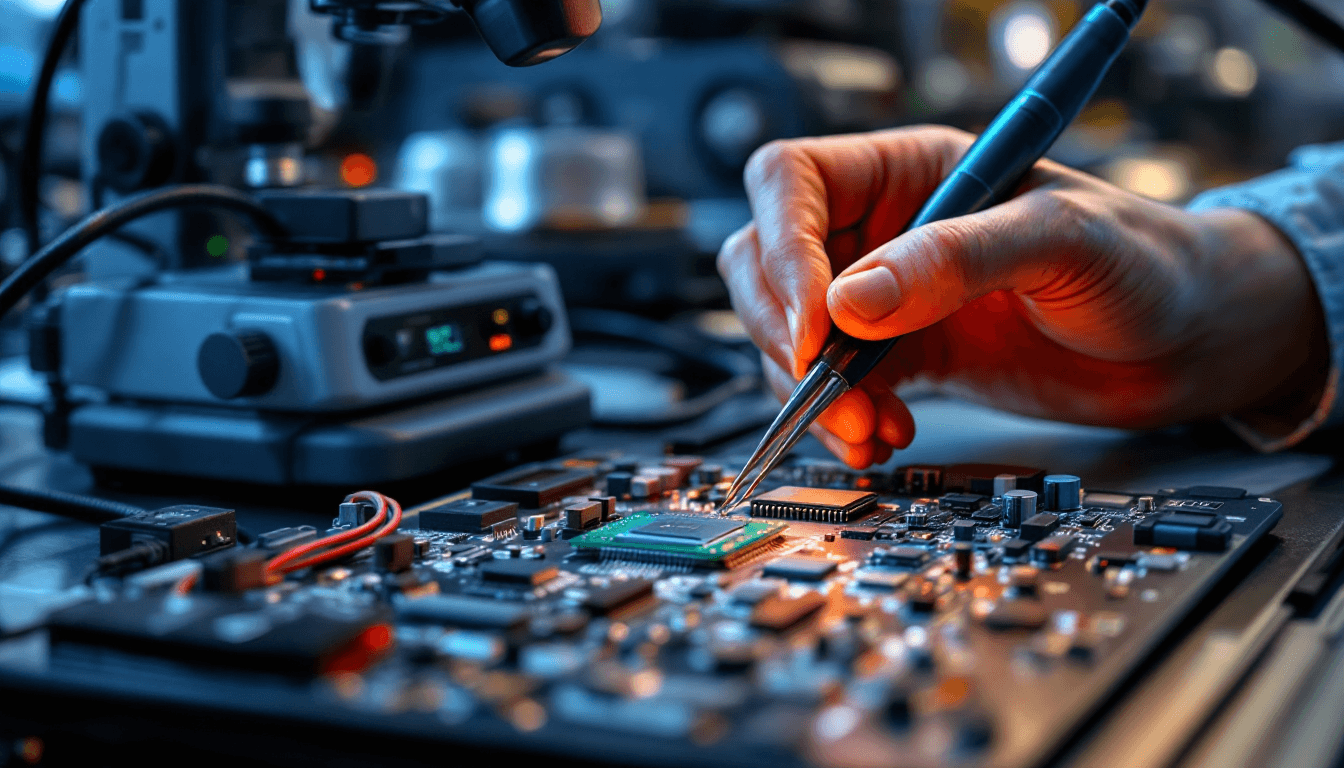
- Soldering and chip-extraction equipment: hot-air rework station, soldering iron, microscope, anti-static workstation. $2,000+ for a credible bench setup.
Per the Associated Locksmiths of America (ALOA), the automotive certification level above the entry-level CRL requires demonstrated proficiency on the bench-level EEPROM platforms. ALOA-certified automotive specialists are a small subset of the overall locksmith population, and asking whether a prospective locksmith holds that credential is a quick way to assess whether they can credibly handle EEPROM work.
Vehicle-by-Vehicle EEPROM Patterns
BMW (E-series and F-series with CAS / FEM-BDC)
BMW vehicles from the E60 5-Series (2003) through the F30 3-Series (2018) use CAS (Car Access System) generations 1–4 or, for F-series 2014+, FEM (Front Electronic Module) and BDC (Body Domain Controller). All-keys-lost on these vehicles requires reading the CAS or FEM/BDC module via OBD or, in cases where OBD-protocol access has been blocked by the factory, via direct bench read. The procedure typically takes 90–180 minutes for an experienced technician on a CAS4 vehicle.
See our dedicated BMW key programming guide for Frisco luxury vehicles for vehicle-year specific procedures.
Mercedes-Benz (EZS/EIS modules, W203 through W213)
Mercedes vehicles from approximately 2003 (W203 C-Class) through 2020 (W213 E-Class, W205 C-Class, X253 GLC) use Electronic Ignition Switch (EIS) modules. All-keys-lost on these vehicles is one of the more demanding bench procedures in the field — the EIS must be physically removed from the steering column, opened, and the EEPROM chip read directly via specialized programmer. For FBS3 (Flexible Belt System 3, late 2009 through approximately 2016), the procedure is manageable with AVDI or specialist tooling. For FBS4 (2016+), the procedure is significantly more complex and typically takes 4–6 hours on the bench.
See our dedicated Mercedes EIS pairing guide for FBS3/FBS4 specifics.
Range Rover / Land Rover (BCM, Discovery and Range Rover lineage)
Range Rover L322, L405, and the L494 Sport, plus Discovery 3 (L319), Discovery 4 (L320), and Discovery 5 (L462), use Body Control Module (BCM) variants that store immobilizer data in EEPROM. All-keys-lost work on these vehicles requires BCM coding using AVDI or equivalent. Procedure typically runs 2–4 hours.
See our dedicated Range Rover BCM coding guide.
Audi / Volkswagen / Porsche (immobilizer 4/5)
VW Group vehicles use a shared immobilizer architecture (IMMO4 from approximately 2004 to 2008, IMMO5 from 2008 forward). For all-keys-lost on IMMO4 vehicles, the cluster instrument typically holds the EEPROM with immobilizer data. For IMMO5 vehicles, the immobilizer data lives in a separate module called the "immo box" or, on newer Audi A4/A5/A6/A7/A8, in the BCM. Bench reads via AVDI or Autel IM608 Pro with Audi/VW license are standard. Porsche vehicles (Cayenne, Macan, Panamera, 911) inherit the VW Group architecture but with additional dealer-only authorizations on some operations.
Real-World Pricing Benchmarks for Frisco (2026)
Frisco is one of the higher-cost markets in DFW for luxury automotive service, both because of the local concentration of high-net-worth households per the U.S. Census QuickFacts for Frisco (median household income roughly $138K) and because the luxury-brand dealerships at Park Place, Sewell, and similar facilities set price expectations at the top of the national range. Realistic mobile-locksmith pricing for EEPROM work runs:
- BMW CAS3 AKL (one key, programmed): $600–$900 mobile vs. $1,400–$2,000 dealership
- BMW CAS4 / FEM-BDC AKL (one key): $750–$1,150 mobile vs. $1,800–$2,400 dealership
- Mercedes EIS FBS3 AKL: $850–$1,200 mobile vs. $1,900–$2,800 dealership
- Mercedes EIS FBS4 AKL: $1,200–$1,800 mobile vs. $2,500–$3,800 dealership
- Range Rover BCM-based AKL: $900–$1,400 mobile vs. $2,200–$3,200 dealership
- VW Group (Audi/Porsche) IMMO5 AKL: $700–$1,100 mobile vs. $1,700–$2,500 dealership
These ranges align with the broader pattern documented in J.D. Power 2024 OEM service-cost benchmarks: mobile specialists running 30–55% below dealership labor rates on equivalent operations.
Real-World Example (Anonymized)
A Frisco resident locked herself out of her 2014 Mercedes E350 (W212 sedan, FBS3 immobilizer) after losing both keys during a moving day. The Mercedes dealership quoted $2,650 for the AKL service plus a 2-week wait for parts. A credentialed mobile automotive locksmith with AVDI tooling completed the same procedure in 3 hours 20 minutes at the residence, charged $980 for the work plus $185 for two replacement OEM-quality keys (total $1,165), and provided a 6-month warranty on the programming. Net savings: $1,485 and 13 days of vehicle access.
The vehicle owner's only out-of-pocket additional cost beyond the locksmith bill was a one-time charge to her auto insurance carrier's roadside coverage for verification of identity at the residence (this is standard for AKL work — locksmiths must verify ownership before performing immobilizer programming, per NASTF Secure Data Release Model requirements).
Expert Perspective
“The single thing separating a credible EEPROM-level automotive locksmith from a general locksmith is the willingness to actually open a module and read a chip. Most general locksmiths refer all all-keys-lost work to dealerships because the bench-level tooling investment runs north of $25K and the learning curve to operate it competently is steep. For Frisco residents driving the luxury vehicles common in this market, finding a locksmith who can credibly do EEPROM work matters more than finding one who answers the phone fastest.”
Frequently Asked Questions
How long does EEPROM key programming take in Frisco?
Most procedures take 1.5–4 hours of on-site work depending on vehicle. BMW CAS4 AKL: ~2 hours. Mercedes FBS3 EIS AKL: ~3 hours. FBS4 work: 4–6 hours and typically requires shop bench time.
Will my insurance cover EEPROM key programming?
Most comprehensive auto policies cover lost-key replacement up to $300–$500. Some carriers, particularly USAA and State Farm in Texas, offer higher limits on luxury-vehicle policies. Check your policy's “personal effects” or “key replacement” line item before assuming out-of-pocket.
Do I need to provide vehicle ownership documentation?
Yes. Per NASTF Secure Data Release Model requirements and Texas DPS Private Security Bureau locksmith licensing rules, a credentialed automotive locksmith must verify ownership before performing immobilizer programming. Bring your title or registration and a government-issued ID.
Can I do EEPROM programming at home with consumer tools?
No. The tooling required (AVDI, IM608 Pro, etc.) is restricted to licensed automotive locksmiths under most manufacturers' cybersecurity requirements. Consumer-grade key programmers do not have EEPROM-level access to luxury-vehicle modules.
How do I verify a locksmith's EEPROM credentials?
Ask for: (1) Texas DPS PSB license number (verifiable at dps.texas.gov/section/private-security), (2) ALOA membership, (3) the specific tooling they use (AVDI, IM608, etc.), (4) NASTF Secure Data Release Model registration. A credentialed specialist will answer all four without hesitation.
What if the locksmith damages my module during EEPROM work?
A licensed Texas automotive locksmith is required to carry liability insurance. Reputable mobile specialists in Frisco carry $1M–$2M general liability plus garage-keepers' coverage. Always confirm coverage and get the warranty terms in writing before authorizing bench-level work.
Next Steps
For EEPROM-level key programming in Frisco TX — including BMW CAS3/CAS4/FEM-BDC, Mercedes EIS FBS3/FBS4, Range Rover BCM, and VW Group IMMO5 — see our automotive key programming service. For all-keys-lost specifically on luxury vehicles, see our luxury all-keys-lost specialist guide. Related vehicle-specific guides: BMW key programming Frisco, Mercedes key replacement Frisco, Range Rover key fob.
Last updated May 2026. Prices and specifications subject to change with market conditions.