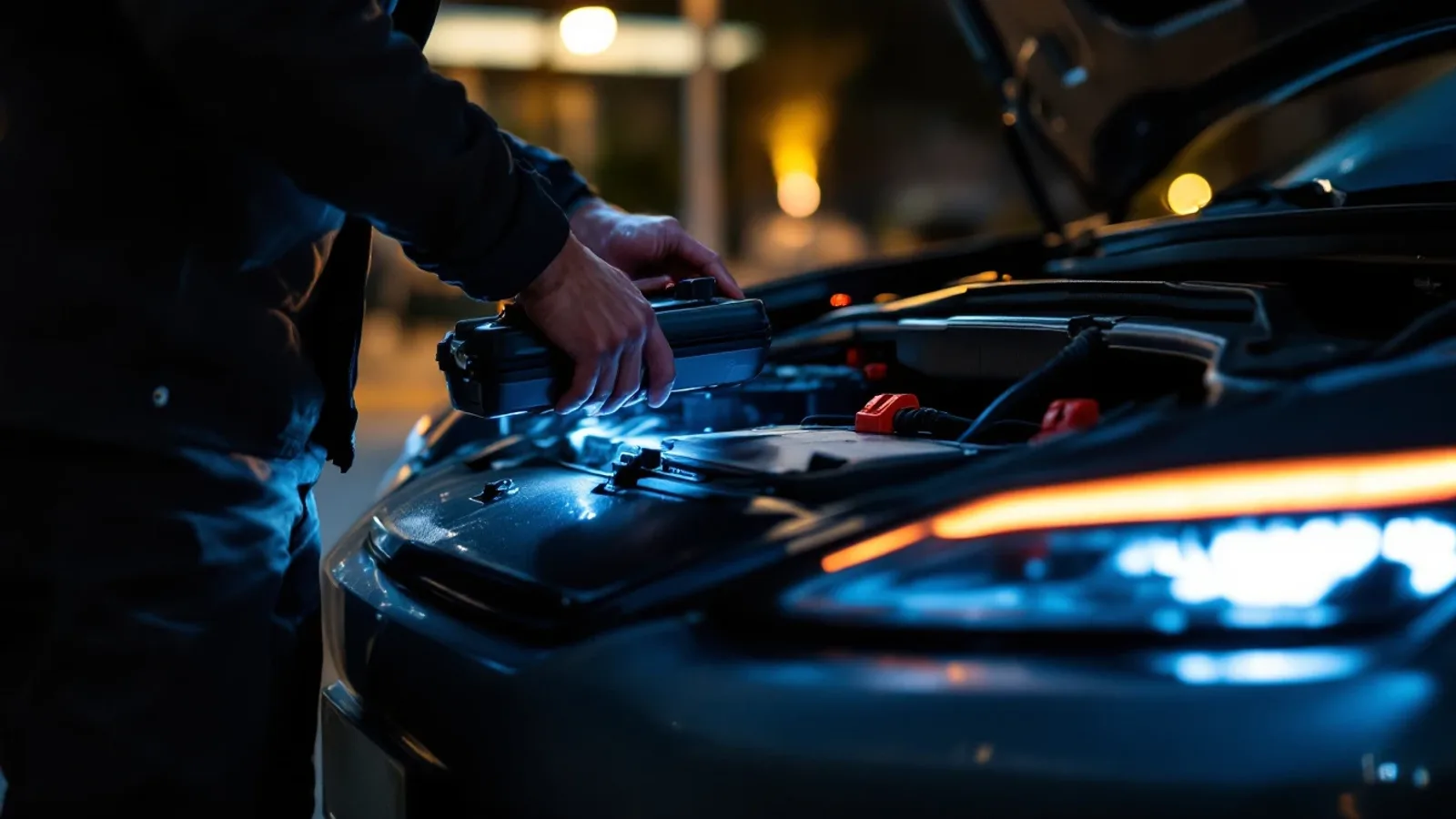
EV 12-Volt Battery Dead, Phone Key Won't Connect in Frisco, TX
As of 2026, a dead EV 12-volt battery bricks doors, frunk and phone key in Frisco, TX. Symptoms, DIY jump points, and when it is a key vs 12V problem.
The EV That Looks Bricked in a Frisco Driveway: 12-Volt Battery vs. Key
You walk up to your electric car in Frisco with your phone in your hand, and nothing happens. The door handles do not present. The frunk button does nothing. The charge port flap will not open. The screen inside is black. Your phone shows the app is "searching," then times out. For a moment it feels like the whole car has died — a $90,000 machine turned into a very large paperweight in your own driveway.
Here is the reassuring truth, and the thing almost nobody tells you until you are standing there: this is very rarely a key problem. The overwhelming majority of the time, the culprit is a small, cheap, ordinary 12-volt auxiliary battery — the same kind of lead-acid or lithium 12V battery a gasoline car uses — quietly failing behind the scenes while the big traction battery that actually drives the car is completely fine. As of July 2026, this is one of the most common EV service calls we take, and once you understand what is happening, it stops being scary.
This guide walks through exactly what a dead 12-volt battery does to a modern EV, how to tell it apart from a genuine key or fob failure, where the emergency jump points hide on popular models, and where a mobile locksmith like Frisco Car Key genuinely helps versus where you need the manufacturer. For an immediate answer about your own car, call or text (469) 402-9781 or email contact@friscocarkeys.com.
Why an EV even has a 12-volt battery
People assume an electric car runs everything off its giant high-voltage pack. It does not. That traction battery — 400 volts and up — is deliberately isolated and only connects to the drive system through contactors that must be commanded closed. The thing that commands them closed, and that powers the door handles, the interior computers, the Bluetooth radio that talks to your phone key, the lighting, and the little motors that pop the frunk and charge port, is a conventional 12-volt system, exactly like a normal car.
That means the 12-volt battery is the ignition switch for the whole vehicle. When it is healthy, the car wakes up, closes the contactors, and the huge pack does its job. When the 12-volt battery is flat, the car cannot wake up to connect the big battery — so a car with a 95% full traction pack can be totally unresponsive because a $150 accessory battery underneath it is dead. It is the classic "a horseshoe nail lost the kingdom" problem.
The symptom picture: what a dead 12-volt battery actually looks like
Because the 12-volt system powers so many small things, its failure has a very recognizable fingerprint. When you see several of these at once, think 12-volt, not key:
- Door handles do not present or respond. On cars with powered flush handles, they need 12V to move. Dead battery, dead handles.
- The frunk and charge-port flap will not open from the button, the app, or the screen — because those are 12V-powered actuators.
- Interior screens are black and the car does not "wake" when you pull a handle or sit inside (if you can get inside).
- The phone key "searches" and never connects. The Bluetooth module in the car needs 12V to answer your phone. No 12V, no handshake — so your perfectly good phone key looks broken.
- The key fob does nothing either — same reason. If both your phone key and a physical fob fail simultaneously, that is a giant clue the problem is the car, not the credential.
- A remote command from the app fails or shows the car as offline.
Contrast that with a genuine key problem, which is almost always narrow and specific: one credential fails while another works. Your phone key struggles but your key card or fob opens the car fine. Or the fob's own coin-cell battery is dead, but the app works. A real key failure rarely takes down the frunk, the screen, and the door handles all at once. Breadth of failure is the tell.
The Texas heat angle
Frisco summers are hard on 12-volt batteries specifically. Heat accelerates the chemical wear of a lead-acid battery and shortens its life, which is why so many "my car is dead" calls cluster in July and August across Collin and Denton County. If your EV is a few years old and has never had its 12-volt battery replaced, a Texas summer is exactly when it decides to quit. We wrote more about how our climate punishes automotive electronics in Texas heat and key fob failures — the same heat that kills fob coin cells is quietly cooking the 12-volt battery too.
The decision tree: is it the key, the fob, or the 12-volt?
Work through this in order before you assume the worst. It takes two minutes and saves a lot of money.
| What you observe | Most likely cause | First move |
|---|---|---|
| Only the phone key fails; fob/card still opens car | Phone key / Bluetooth glitch | Restart phone, toggle Bluetooth, reopen app |
| Only the fob fails; phone app still works | Fob coin-cell battery dead | Replace CR2032-type cell, use backup credential |
| Phone key, fob, AND doors/frunk/screen all dead | 12-volt auxiliary battery flat | Locate 12V jump points; get 12V power to car |
| Car was fine, sat unused 2+ weeks, now unresponsive | 12-volt drained ("vampire" idle drain) | Jump the 12V; then have battery tested |
| Everything dead AND traction battery showed near-empty | High-voltage pack depleted | Manufacturer roadside / charging, not a key issue |
| One credential works but car drives strangely, warnings | 12-volt weak but not fully dead | Drive to service; replace 12V soon |
The single most useful question is the third row: does more than the key fail? If the answer is yes — if the physical car itself is unresponsive across multiple systems — you are looking at a 12-volt problem, and no amount of key programming will fix it.
Getting into a "bricked" EV: the emergency access most owners never learn
Manufacturers know the 12-volt-dead scenario happens, so nearly every EV has a mechanical or low-voltage emergency access path. The trouble is that owners almost never read that page of the manual until they are stranded. Here is the general shape, by common brand — always confirm against your own owner's manual, because details differ by model year.
- Tesla (Model 3/Y/S/X): There is a physical, hidden emergency-unlock path and external 12-volt terminals designed for exactly this. On many models you pop a small cover to reach positive and negative posts, apply 12V from a portable jump pack or another car's 12V, and the frunk/doors come alive. Some models also have a mechanical door release inside. Tesla's own documentation at tesla.com/support is authoritative here — and if you have never lost all credentials, our honest look at Tesla key cards and phone keys explains where a locksmith fits.
- Rivian (R1T/R1S): Rivian provides emergency 12-volt access points and a documented procedure to energize the vehicle enough to open. We cover the ownership side in Rivian key replacement in Frisco.
- Most German and Korean luxury EVs (EQ Mercedes, i-series BMW, e-tron Audi, EV6/Ioniq, Genesis): These typically retain a hidden mechanical key blade inside the fob and a concealed lock cylinder under a trim cap on the driver's door, plus under-hood or fuse-box 12V jump posts. The mechanical blade lets you physically unlock the door even with zero electrical power — which is exactly why keeping the emergency blade in your fob matters.
The universal principle: feed the car 12 volts, or use the mechanical blade, and the "bricked" car wakes up. You are not reviving the giant battery — you are just giving the car enough juice to open and connect so it can then close its own contactors.
DIY jump points — do it safely
If you are comfortable and your manual documents it, applying 12V to the designated emergency posts is a reasonable roadside DIY. A few safety rules:
- Use the manufacturer-designated posts only. Do not clamp onto random busbars. High-voltage components live nearby in an EV, and guessing is dangerous.
- A small portable 12V jump pack is plenty. You are not cranking a starter motor; you are waking electronics. Even a modest pack works.
- Observe polarity carefully. Reversed polarity can damage EV electronics that are far more expensive than a starter.
- Once the car wakes, get in and check the screen. It will usually warn that the 12-volt battery needs service. Believe it — a battery that died once will die again soon.
- If anything is uncertain, stop. An EV is not the place to improvise. This is precisely when a mobile professional earns their fee.
Where a mobile locksmith genuinely helps — and where we don't
Let us be honest about the boundary, because that honesty is the whole point.
Where Frisco Car Key helps directly:
- Non-destructive entry. If your handles are dead and you cannot get in — no mechanical blade, no obvious jump access from outside — a skilled mobile locksmith can perform a careful, damage-free car lockout entry to get you inside so you can reach the interior release or 12V access, then restore power. On an EV with expensive flush glass and trim, doing this without a scratch is a genuine skill, not a pry bar.
- A physical key backup. Many luxury EV owners drive entirely on the phone key and have never even removed the emergency blade from their fob — some do not know they have one. We can help you confirm you have a working mechanical backup and a spare credential, so a dead 12-volt battery never fully traps you again.
- Diagnosis and triage. We tell you, on the spot, whether you are looking at a two-minute 12-volt jump, a dead fob coin cell, or a genuine credential problem — so you do not pay for the wrong fix.
- Fob and spare-key work on the EVs where it applies. For EVs that use a conventional smart key alongside the phone key, we can cut the emergency blade and, where the platform allows, help with smart key programming.
Where we send you to the manufacturer instead:
- A truly depleted high-voltage traction pack (the big battery genuinely empty) is a charging/roadside matter, not a key or lockout issue.
- Account-level EV credential enrollment — pairing a new phone key through the car's screen and the brand's app — runs through the vehicle's own system and your manufacturer account, not an aftermarket tool.
- Replacing the 12-volt battery on some EVs involves service procedures best done by a shop.
The Federal Trade Commission's consumer guidance is worth remembering: get the scope of any service stated clearly before you pay, and be skeptical of anyone promising a capability that sounds too convenient (ftc.gov). If a company tells you your dead-in-the-driveway EV needs an expensive "reprogram," when the real fix is a $150 12-volt battery, that is a red flag.
"The call we get is always 'my car is bricked, the key stopped working.' Nine times out of ten it's the twelve-volt, and the key never had a thing wrong with it. The professional move is to prove that to the customer in two minutes and not sell them a programming job they don't need." — an automotive locksmith, name withheld by request
What proper roadside and anti-theft practice looks like
Even in a simple lockout, a reputable locksmith verifies you are the owner or an authorized driver before opening any vehicle. Bring a government-issued photo ID and proof of ownership — registration, title, or a finance/lease agreement in your name. This is standard ethical practice consistent with the professional standards published by the Associated Locksmiths of America (aloa.org), and it protects your car from exactly the kind of unauthorized entry you would never want a stranger performing on it.
For roadside planning, national resources like AAA outline how vehicle lockout and jump assistance work and what to expect (aaa.com). And on the security side, the anti-theft immobilizer technology that makes modern keys secure in the first place is documented by the National Highway Traffic Safety Administration and the Insurance Institute for Highway Safety (nhtsa.gov; iihs.org). Secure key and credential data handling in the trade is governed by frameworks from the National Automotive Service Task Force (nastf.org) — the same standards that keep your EV's credentials from being trivially cloned.
Prevention: never get bricked in your own driveway again
A dead 12-volt battery is one of the most preventable EV emergencies. A few habits in Frisco's climate go a long way:
- Replace the 12-volt battery proactively at 3–4 years, sooner if you park outside in the Texas sun. Do not wait for it to strand you.
- Believe the warning. When your EV displays "12-volt battery needs service," that is your one free warning. Act within days, not weeks.
- Drive it occasionally if it sits. A car parked for weeks — a second car, a vacation vehicle — slowly drains its 12-volt through idle "vampire" loads. A short drive or a maintainer keeps it topped up.
- Know your emergency access before you need it. Read the one page of your manual about mechanical door release and 12V jump points. Keep the emergency blade in your fob.
- Keep a spare physical credential. Whether that is a key card, a fob, or a second phone with the app, redundancy is the cheapest insurance there is.
Serving Frisco and the surrounding area
Frisco Car Key is a fully mobile automotive locksmith covering Frisco, Plano, McKinney, Allen, Prosper, and The Colony. Whether your EV is dead in your own garage, at an office in Hall Park, or at a charger with a phone key that will not connect, we come to the vehicle, diagnose honestly, and either get you moving or point you to the right resource. Learn more on our about page or reach us through the contact page.
Frequently Asked Questions
My EV is totally unresponsive — is my key broken?
Almost certainly not. When the phone key, the fob, the door handles, the frunk, and the screen all fail at once, the common cause is a dead 12-volt auxiliary battery, which powers all of those systems. A real key failure is usually narrow — one credential stops working while another still opens the car. Broad, everything-at-once failure points at the 12-volt battery, not the key.
Can a dead 12-volt battery really disable a car with a full traction pack?
Yes, and it is one of the more counterintuitive facts about EVs. The 12-volt system is what wakes the car and commands the contactors that connect the big high-voltage pack. If the 12-volt battery is flat, the car cannot wake up to use the traction battery — so a 95% full EV can be completely unresponsive because a small accessory battery underneath it has died.
How do I get into my EV when the 12-volt battery is dead?
Most EVs have a documented emergency access path: external or under-hood 12-volt jump posts you energize with a portable jump pack, and often a hidden mechanical key blade inside the fob that unlocks the driver's door with no power at all. Confirm the exact procedure in your owner's manual. If you cannot access it, a mobile locksmith can perform a non-destructive entry to get you inside.
Is it safe to jump-start an EV's 12-volt battery myself?
It can be, if your manual documents the designated jump points and you observe polarity carefully. Use only the manufacturer-designated posts, use a small 12-volt jump pack rather than trying to crank it like a gas car, and stop if anything is unclear — high-voltage components live nearby. Reversed polarity can damage expensive EV electronics, so when in doubt, call a professional.
Will a locksmith replace my EV's 12-volt battery?
We can diagnose the 12-volt battery as the cause on the spot and get you back into and powering a bricked car, and on many vehicles the 12-volt replacement is straightforward. On some EVs the replacement involves service procedures better handled by a shop. What we will never do is sell you a "reprogram" when the real fix is a battery — we tell you exactly what you need.
Why does this happen so often in Frisco summers?
Heat is hard on 12-volt lead-acid batteries. Frisco's July and August temperatures accelerate the chemical wear inside the battery and shorten its life, which is why dead-battery lockouts spike in summer across Collin and Denton County. If your EV's 12-volt battery is several years old, a Texas summer is exactly when it tends to quit.
How do I stop my EV from getting bricked again?
Replace the 12-volt battery proactively every three to four years, sooner if you park in the sun. Act quickly when the car warns you the 12-volt battery needs service. Drive the car occasionally if it sits for weeks. Learn your emergency mechanical-release and 12V jump points before you need them, and keep the emergency blade in your fob plus a spare credential handy.
References
- National Highway Traffic Safety Administration — vehicle anti-theft, immobilizer, and battery safety: https://www.nhtsa.gov
- AAA — roadside assistance, vehicle lockout, and jump-start consumer resources: https://www.aaa.com
- Associated Locksmiths of America (ALOA) — professional and ethical standards for automotive locksmiths: https://www.aloa.org
- National Automotive Service Task Force (NASTF) — Secure Data Release System and key/security frameworks: https://www.nastf.org
- Insurance Institute for Highway Safety (IIHS) — anti-theft and immobilizer research: https://www.iihs.org
- Federal Trade Commission (FTC) — consumer guidance on service scope and avoiding scams: https://www.ftc.gov
Frisco Car Key is a mobile automotive locksmith serving Frisco, TX and surrounding Collin and Denton County communities. Call or text (469) 402-9781 or email contact@friscocarkeys.com. For high-voltage battery, charging, and account-level credential issues, your EV manufacturer's official channels are the authoritative source. This article is informational.
Related Guides
BMW i4, i5, i7 & iX Key Replacement in Frisco, TX: Comfort Access & Digital Key
How BMW i-series EV owners in Frisco replace or add a key — Comfort Access fobs, Digital Key on your phone, all-keys-lost realities, and honest pricing.
Mercedes EQS & EQE Key Replacement in Frisco, TX: Keyless-Go, Spare & AKL
Mercedes-Benz EQ owners in Frisco: how to replace or add an EQS/EQE smart key, how Keyless-Go works, what all-keys-lost really involves, and honest pricing.
Polestar 2 & 3 Key Replacement in Frisco, TX: Fob, Digital Key & AKL
Polestar owners in Frisco: replacing or adding a key fob, how the Polestar Digital Key works, the Volvo-shared tech behind it, and honest EV key pricing.