Relay Theft & Keyless Entry Security for Luxury Cars in Frisco, TX
2026 relay theft & keyless security guide for luxury cars in Frisco, TX. How signal-amplification attacks work, Faraday pouches, spare keys. Call (469)
Relay Theft & Keyless Entry Security for Luxury Cars in Frisco, TX
If you drive a keyless-entry luxury car in Frisco, you've probably heard about "relay theft" — the attack where a car is stolen from a driveway in under a minute without the thief ever touching your keys. It's a real phenomenon, and the affluent North Texas suburbs are exactly the kind of place where premium vehicles make attractive targets. But the topic is also surrounded by a lot of fear and misinformation. This guide explains, factually and without scare tactics, how relay theft actually works, what genuinely defends against it, and where a locksmith fits into a sensible security plan.
Frisco Car Key is a fully mobile automotive locksmith serving Frisco and its high-income neighbors. As of July 2026, our position on keyless security is straightforward: understand the real risk, adopt a few free habits, add inexpensive tools if your car warrants them, and keep a verified spare key so a security scare never turns into a stranded-vehicle emergency. We're not in the business of frightening owners into unnecessary purchases — we're here to give you accurate information and honest service. Reach us at Frisco Car Key, (469) 402-9781, contact@friscocarkeys.com.
How Keyless Entry Actually Works
To understand relay theft, you first need to understand what a proximity smart key does. A modern luxury key fob is a small two-way radio. When you approach the car, the vehicle continuously broadcasts a low-power signal looking for its key. When your fob hears that signal and is close enough, it answers with an encrypted credential, and the car unlocks or allows push-button start. You never press a button — the "passive" convenience is the whole point.
That convenience is also the mechanism a relay attack exploits. The car doesn't measure how far away the key really is; it only knows whether it can hear the key's response. If that response can be captured and carried closer to the car, the car behaves as though the key is right next to it. The encryption itself isn't broken in a relay attack — the thieves don't crack your code. They simply extend the range of a legitimate conversation between your car and your key.
The immobilizer that prevents a car from being hot-wired is a separate and highly effective layer; the National Highway Traffic Safety Administration (NHTSA) has documented how immobilizers dramatically reduced drive-away theft industry-wide. Relay theft is essentially a workaround for that success — a way to convince the car that the authorized key is present rather than defeating the immobilizer directly.
How a Relay Attack Works, Step by Step
A typical relay theft involves two people and two radio devices:
- One thief stands near your home with a device that detects and captures the fob's signal. Fobs commonly sit near a front door, on a hook in an entryway, or in a bag close to an exterior wall — well within range.
- A second thief stands by the car with a paired device that relays the captured signal to the vehicle.
- The car "hears" the key through the relayed link, unlocks, and permits start.
- The car is driven away. Because it thinks the authorized key was present, no alarm of forced entry is triggered.
The whole sequence can take under a minute and is silent. Critically, it depends on the fob being reachable from outside your home — which is exactly why the defenses below focus on breaking that radio link. The Insurance Institute for Highway Safety (IIHS) studies vehicle theft and anti-theft effectiveness, and the consistent theme is that layered, practical measures work better than any single silver bullet.
"Relay theft isn't magic and it isn't hopeless. It's a radio-range trick that depends on reaching your fob through a wall. Break that link — a pouch, a metal box, distance from the door — and you've defeated the most common version of the attack for the price of a coffee. I'd rather an owner know that than buy something they don't need." — a Frisco Car Key mobile locksmith technician credentialed for automotive immobilizer work
The Defenses That Actually Work
The good news is that the most effective defenses against relay theft are cheap or free. You don't need to disable convenience features you paid for.
Store your fob away from doors and windows. The single most effective free habit is to keep your keys deep inside the home, away from the exterior walls nearest your driveway. Distance and interior walls attenuate the signal. Moving the fob from a hook by the front door to a drawer in an interior room meaningfully reduces reachability.
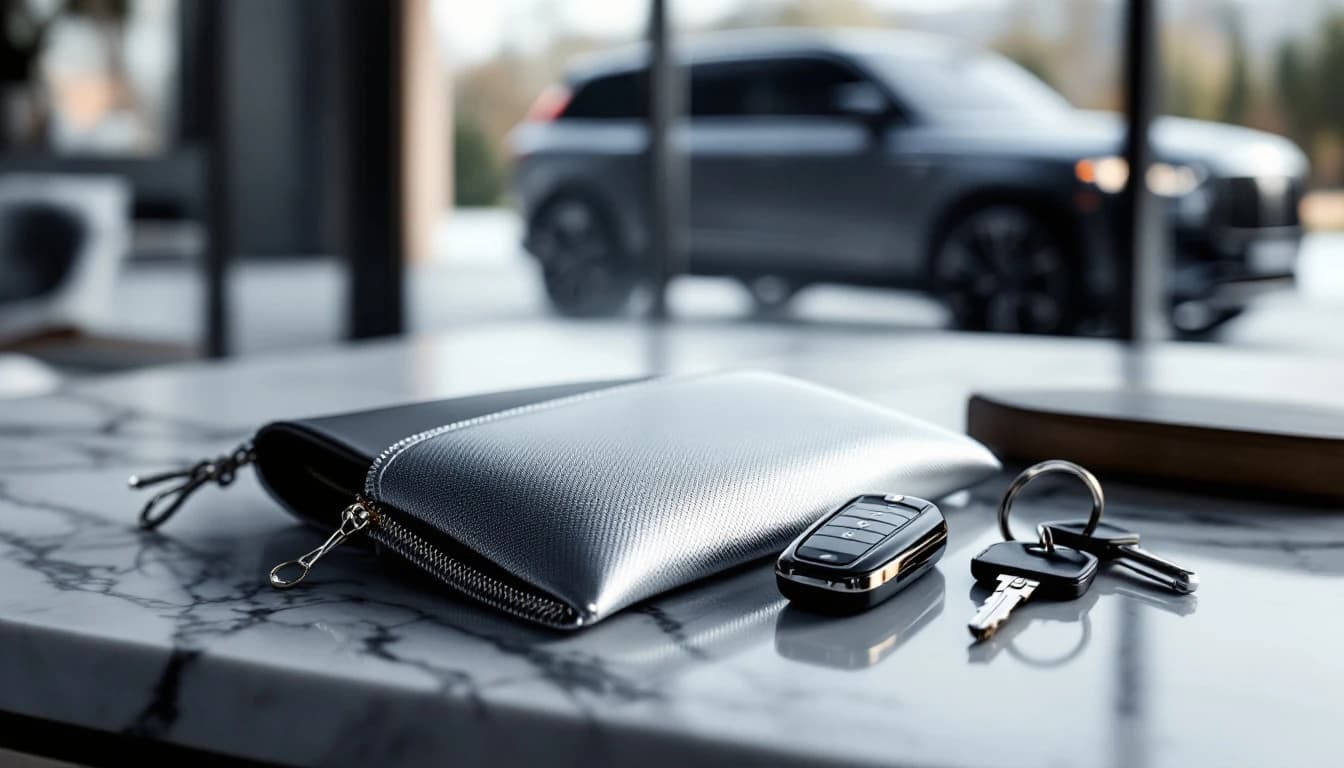
Use a Faraday pouch or box. A signal-blocking pouch (often called a Faraday pouch) or a metal container lined for RF shielding prevents the fob from transmitting or receiving while stored. When the fob is inside a working pouch, it simply can't participate in a relayed conversation. Faraday pouches are inexpensive and widely available; the key is to test yours — put the fob inside, close it, and confirm the car no longer responds when you stand next to it.
Check for a fob "sleep" or motion-sensing mode. Many newer luxury fobs enter a low-power sleep state when they've been motionless for a period, so a fob resting overnight stops broadcasting. Consult your owner's manual; if your fob supports this, no accessory is needed at all.
Park defensively. A car parked in a locked garage is far harder to relay-steal than one in an open driveway. Where a garage isn't available, parking a less-valuable vehicle behind the target car is a simple physical obstacle.
Consider a visible deterrent. A steering-wheel lock or a visible wheel clamp doesn't stop the radio link, but it forces a thief to spend time and make noise, and many will simply move on to an easier target. The Federal Trade Commission (FTC) publishes consumer guidance encouraging people to weigh cost against real benefit before buying security products — visible deterrents are a low-cost, high-visibility example that often pays off.
What a Locksmith Adds to Your Security Plan
A mobile automotive locksmith isn't a security-system installer, but there are two concrete ways we strengthen a keyless-entry owner's position — both grounded in what we actually do.
A verified spare key. This is the most underrated security measure of all, and we'll return to it below. A spare doesn't prevent theft, but it removes the single point of failure in your key situation, so a lost or compromised fob never escalates into an all-keys-lost emergency.
Honest smart-key programming. If a fob is ever lost, stolen, or believed compromised, the correct response is to have the vehicle's key credentials handled properly. Our smart key programming service covers replacing and programming proximity fobs on serviceable makes and models, always with ownership verification first. On the newest platforms where key generation is manufacturer-controlled, we tell you honestly and refer you appropriately rather than attempt something we can't finish.
The National Automotive Service Task Force (NASTF) provides the legitimate channel through which vetted independent locksmiths obtain security information and secure vehicle access, and the Associated Locksmiths of America (ALOA) sets the professional standards that keep this work legitimate. A locksmith who verifies ownership and works within the manufacturer-sanctioned framework is part of your security, not a loophole in it.
Relay Theft Risk and Defenses at a Glance
The table below summarizes how the common defenses map to the way a relay attack works. None of these require disabling features you enjoy.
| Defense | What It Does | Cost | Effort |
|---|---|---|---|
| Faraday pouch or box | Blocks the fob's radio signal while stored | Low | One-time setup, test it |
| Fob away from doors/windows | Reduces signal reachability from outside | Free | A new habit |
| Fob sleep / motion mode | Fob stops broadcasting when still | Free | Check the manual |
| Locked garage parking | Adds physical distance and a barrier | Varies | Where available |
| Steering-wheel lock | Visible deterrent; costs the thief time | Low | Use it each time |
| Verified spare key | Removes single-point-of-failure risk | Low–Moderate | One appointment |
| Proper reprogramming if fob lost | Restores control of key credentials | Moderate | Call a locksmith |
Why a Proactive Spare Is Part of Security, Not Just Convenience
People think of a spare key as convenience insurance — and it is — but on a keyless luxury car it's also part of your security posture. Here's the connection. If you ever believe a fob has been lost, stolen, or compromised, the responsible move is to reprogram the car's key credentials so the missing fob no longer works. That process is dramatically easier and cheaper when you still have a working key to authorize it. If your only fob is the one that went missing, you're now in an all-keys-lost scenario — the most expensive and involved key situation there is, and on some luxury platforms one that routes through the dealer.
In other words, keeping a verified spare means a security scare is a manageable reprogramming appointment rather than an emergency. AAA's member preparedness guidance frames a backup key as a fundamental safeguard, and AAA applies that logic across all vehicles; on a keyless luxury car, the security dimension makes the case even stronger. A spare stored safely at home — ideally in its own Faraday pouch — is cheap insurance against both a lost key and a compromised one.
For Frisco households with more than one premium vehicle, the same logic scales. Every keyless car in the garage benefits from a verified spare, and a single relationship with an honest mobile locksmith covers all of them. Our car key replacement and key duplication services exist precisely so that adding a spare is a simple, scheduled thing rather than a scramble.
A Word on Not Panicking
It's worth saying plainly: relay theft is real, but it is not a reason to live in fear or to distrust the keyless system you paid for. The overwhelming majority of the defense is free — move your keys away from the front door and confirm whether your fob already sleeps when idle. A modest additional spend on a tested Faraday pouch and a visible steering lock closes most of the remaining gap. And keeping a verified spare ensures that even a worst-case lost-or-stolen fob is a controlled, affordable fix rather than a crisis.
The measured approach also protects you from the opposite problem — overspending on gadgets that don't address the actual mechanism. The FTC consistently advises consumers to match the cost of a security purchase to the real risk it mitigates. A $15 pouch that you actually test beats a $500 device you don't understand.
Licensing and Legitimacy in Texas
If you ever do need key work — replacing a compromised fob, adding a spare, or handling a lost key — use a legitimate locksmith. In Texas, locksmith and access-control companies operate under the Texas Department of Public Safety (DPS) Private Security Bureau. A legitimate mobile locksmith identifies the business, carries insurance, and verifies vehicle ownership before any key work. That ownership verification is itself an anti-theft measure: it's the same rigor that keeps stolen vehicles from being re-keyed by the wrong hands. Refusing to program a key for someone who can't prove ownership isn't friction — it's exactly the standard ALOA promotes.
We serve Frisco, Plano, McKinney, Allen, The Colony, and Prosper. Learn more about our team or contact us.
Frequently Asked Questions
Is relay theft really a risk for luxury cars in Frisco?
Relay theft is a real technique that targets keyless-entry vehicles, and premium cars in affluent areas are naturally more attractive to thieves. That said, it's neither magic nor unstoppable. The attack depends on reaching your fob's signal from outside your home, which means the defenses — storing the fob away from doors, using a Faraday pouch, and confirming whether your fob sleeps when idle — are cheap and effective. The realistic posture is awareness plus a few simple habits, not fear.
How does a relay or signal-amplification attack actually work?
A proximity fob answers the car's continuous "are you nearby?" signal automatically. In a relay attack, one thief captures that signal near your home while a second relays it to the car, tricking the vehicle into behaving as if the key is present. The encryption isn't broken — the thieves simply extend the range of a legitimate conversation between the car and its key. That's why breaking the radio link, rather than trying to strengthen the code, is the effective defense.
Do Faraday pouches actually block relay theft?
A working Faraday pouch or metal box prevents the fob from transmitting or receiving while it's stored, so the fob can't participate in a relayed conversation. They're inexpensive and effective — but you must test yours. Put the fob inside, close it, stand next to your car, and confirm the car no longer responds. If the car still detects the key, the pouch isn't sealing properly. A tested pouch, combined with keeping keys away from exterior doors, closes most of the gap for very little money.
Will disabling keyless entry protect my car?
You generally don't need to disable a convenience feature you paid for. Many newer fobs already enter a low-power sleep mode when motionless, and a tested Faraday pouch achieves the same protection on demand. Check your owner's manual for a sleep or motion-sensing mode first. If your fob supports it, you get strong protection with no accessories and no loss of convenience when you're actually using the car.
If I think my fob was stolen or compromised, what should I do?
The responsible step is to have the vehicle's key credentials reprogrammed so the missing fob no longer works. This is far easier and cheaper if you still have a working spare to authorize the process — which is one more reason to keep a verified spare. A legitimate mobile locksmith can handle reprogramming on serviceable makes after verifying your ownership, or refer you appropriately on the newest platforms where key generation is manufacturer-controlled.
How is a spare key a security measure and not just convenience?
If a fob is lost or compromised, reprogramming the car to lock out the missing key is dramatically simpler with a working key in hand. Without one, you're in an all-keys-lost situation — the most involved and expensive key scenario, and on some luxury platforms a dealer-only job. So a verified spare turns a potential security emergency into a routine appointment. Store the spare safely at home, ideally in its own Faraday pouch, and a lost or stolen fob never becomes a crisis.
Should I spend money on anti-theft gadgets?
Match the spend to the real risk. The most effective defenses — moving your keys and enabling a fob sleep mode — are free, and a tested Faraday pouch plus a visible steering-wheel lock are inexpensive. Consumer guidance from the FTC consistently advises weighing cost against real benefit before buying security products. A cheap pouch you actually test and a visible deterrent that costs a thief time will outperform an expensive device you don't fully understand.
Ready to Add a Spare or Reprogram a Lost Fob in Frisco?
Frisco Car Key gives keyless-car owners accurate information and honest service — no scare tactics, no upselling gadgets you don't need. If you want a verified spare for your luxury car, or you need a lost or compromised fob handled properly, call or text (469) 402-9781 or email contact@friscocarkeys.com. We verify ownership, work within the manufacturer-sanctioned framework, and offer same-day mobile service across Frisco and North Texas where feasible.
References
- National Highway Traffic Safety Administration (NHTSA) — immobilizer technology and vehicle theft: https://www.nhtsa.gov
- Insurance Institute for Highway Safety (IIHS) — vehicle theft and anti-theft effectiveness research: https://www.iihs.org
- Federal Trade Commission (FTC) — consumer guidance on security products and service pricing: https://www.ftc.gov
- National Automotive Service Task Force (NASTF) — secure data and vehicle access for independents: https://www.nastf.org
- Associated Locksmiths of America (ALOA) — professional locksmith standards: https://www.aloa.org
- AAA — member guidance on automotive locksmith and roadside services: https://www.aaa.com
Related Guides
Broken Car Key Extraction & Replacement in Frisco, TX
A Frisco guide to broken car key extraction — how a key snaps in an ignition or door lock, damage-free removal, when the cylinder itself is worn, and cutting a fresh key with honest mobile cost ranges.
Texas Heat & Key Fob Failures in Frisco, TX
A Frisco seasonal guide to how extreme North Texas summer heat affects key fob batteries and electronics — dead-fob symptoms, telling the battery from the fob from the ignition, and the mobile fixes that get you moving.
Auto Car Keys Replacement in Frisco TX: Mobile Key Cutting & Programming
Get fast mobile auto car keys replacement in Frisco TX. Our expert service ensures quick key cutting and programming. Contact us today for help!