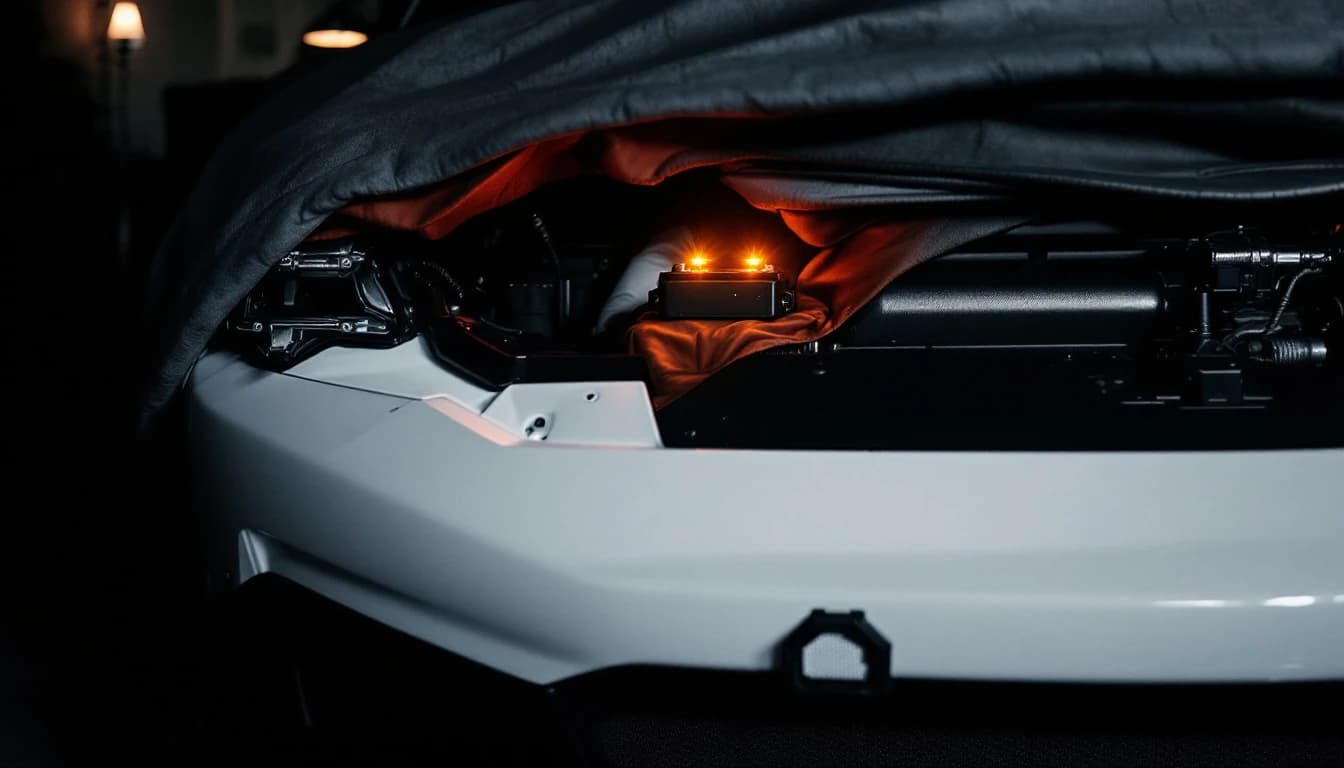
A Garage-Kept Exotic That Won't Wake Up for the Key in Frisco, TX
Stored car will not recognize the key in Frisco, TX? Why it is usually 12-volt or sleep mode, not the fob, and how to wake it without wrecking a module.
The Symptom
The car has sat for six weeks, or three months, or since March. It lives in a clean, climate-controlled garage in Frisco. There is a maintainer on it and the light is green. You walk up with the key and nothing happens - no unlock chirp, no mirrors folding out, no dash wake. Or it wakes for two seconds, throws four warning messages and dies again.
The instinct almost everyone has is that the key died. It almost never is the key.
The short answer: on a stored modern car this is overwhelmingly a 12-volt problem - a battery sitting below the voltage where the body and immobilizer modules will reliably authenticate, a maintainer that is not actually delivering, or a maintainer set for the wrong battery chemistry. Second is a storage state the owner forgot: a disconnect switch, or a transport or deep-sleep mode the car went into on its own. The key's own coin cell is a real but distant third. And on an EV or plug-in hybrid the high-voltage system will not close its contactors at all while the 12-volt side is weak, which looks exactly like a dead car.
As of September 2026 that is the order we find them in, and the order matters more here than on almost any other symptom - because the wrong first move on a high-value car costs real money.
Frisco Car Key is a fully mobile automotive locksmith. Frisco Car Key, (469) 402-9781, contact@friscocarkeys.com.
Read This Before You Reach for Jumper Cables
A modern exotic, luxury or electrified car is a network of computers sharing a bus. During a wake sequence those modules are booting, handshaking, and in some cases writing to memory. A voltage spike, a reversed clamp, a cheap booster pack dumping current mid-handshake, or a jump applied at the wrong point can produce genuine module faults that outlast the dead battery by a long way. We have been called to cars where the original problem was a flat battery and the current problem is a control module that needs coding because somebody boosted it badly.
So: do not improvise on a high-value vehicle - cables and a neighbor's truck is the approach most likely to turn a free fix into a four-figure one. Use the manufacturer's designated jump points if you use anything, since many of these cars do not want you at the terminals directly and several place remote posts under a hood panel or in a wheel well for exactly this reason. Prefer slow charging over boosting, because a charger brought up over hours is gentler than anything delivering a surge, and on a deeply discharged battery slow is the only thing that will actually recover it. Do not repeatedly crank a car that is browning out - each attempt drops voltage further and gives the modules another marginal boot cycle to survive.
And be honest about what can be judged remotely: we cannot tell you over the phone whether your platform is safe to boost, and neither can anybody who has not seen it. AAA has published roadside guidance on correct jump-start procedure for years, and the short version has not changed - order of operations and the right attachment points matter more than the size of the booster.
Why Storage Does This
Parasitic draw never stops. Alarm, telematics, keyless receivers, tire sensors and body modules with timers all draw current continuously. It is modest, but over weeks it is decisive, and on a feature-heavy car it is larger than owners expect.
Batteries age in heat even when nothing is driving them. A garage in Frisco in August is warm even when climate-controlled relative to outside, and sustained heat shortens battery life whether the car moves or not. A battery with two more years of daily driving in it can be finished by one summer of sitting.
Modules go to sleep in stages. Layered sleep states reduce that draw, and waking them has an order. A partial wake - some modules up, the one that authenticates your key not - presents to the owner as a dead key. The car is not ignoring you; it has not finished getting up.
The Causes, Ranked
1. The 12-volt battery is below the authentication threshold
The answer most of the time, and the nuance that matters is that below the threshold is well above dead. A battery can read a plausible voltage, still turn the interior lights on, and be nowhere near able to support a full wake sequence with a network of modules booting at once. The body module gets a marginal supply, the immobilizer handshake with your key times out, and the car tells you nothing is there.
The tells: something responds - a click, a flicker, a brief dash - then nothing. Or a wake followed by a cascade of unrelated warnings, which is what modules that just browned out report. Or it works on the third try, which is worse news rather than better, because you are living on the edge of the threshold.
2. The maintainer is not doing what the light says
Its own rank, because the green light is the most misleading data point in this whole symptom. It was never delivering - a GFCI tripped in March, the lead pulled loose when the cover went on, the cord is on a switched outlet, the clamp is on a painted bracket rather than clean metal. It is set for the wrong chemistry - the one that catches careful owners, because a charger in flooded lead-acid mode will not correctly bring up an AGM battery, and a lead-acid charger on a lithium battery is either ineffective or genuinely unsafe. It is a maintainer, not a charger - some units hold a healthy battery at float and lack the output to recover one that has gone deeply flat, so they sit there indefinitely reporting that everything is fine. It is on the wrong side of a disconnect - with the switch open it may be charging nothing at all.
If the maintainer has a chemistry selector and nobody has looked at it since the last battery was fitted, look now.
3. A disconnect switch, storage mode or transport mode
Owners of stored cars do sensible things and forget them: a cut-off switch turned off in the trunk or under a seat, a pull-tab isolator, a storage or valet mode selected in a menu. Some vehicles also enter their own deep sleep or transport-style state after long enough without use, by design and documented in the manual. Any of those produce a car that appears dead and is perfectly healthy - free to rule out, and embarrassing to find at the end of a long diagnosis rather than the beginning.
4. Deep sleep and a partial wake sequence
Distinct from cause three because nobody chose it. On several platforms the correct way to bring a long-parked car up is not simply pressing the start button. It is: get the doors open, let the car see a valid key, give the network time to come up, then start. Do it out of order and the car responds to the wrong thing at the wrong moment and drops back down. This is also where a weak battery and a sleep state conspire, because a wake sequence is the highest-demand moment for a stored car's electrical system - a marginal battery fails precisely when you are asking the most of it.
5. The key fob coin cell degraded while stored
Worth checking because it is trivial. A coin cell has a shelf life and a temperature sensitivity, and a fob left in a hot glovebox or a warm garage drawer for a season can come out weaker than it went in.
Two things put this lower than owners expect. A fob with a weak battery usually still works held against the start button or placed in the designated backup key pocket - most of these vehicles have one, often in the console or on the column, using a short-range coil that needs almost nothing from the fob's own cell. And a fob failure does not explain a car with no signs of life at all. If the doors do not respond and no interior lights come on, the key is not your problem.
6. Immobilizer or module relearn demanded after a long low-voltage event
After a deep discharge or a series of brownouts, some platforms come back with modules that have lost synchronization, stored fault codes needing clearing, and occasionally an immobilizer wanting a relearn before it will authorize a start. That is real work rather than a battery charge, and it sits in the ECU and module programming band, $200 to $800. The shape of the job is described in our walkthrough of immobilizer module programming, and it is what our ECU and module programming service covers. Worth being clear: this is usually a consequence of the low-voltage event rather than an independent cause, so fix the power first and a good share of these resolve themselves.
7. On an EV or plug-in hybrid: the high-voltage side will not close
On an electrified car the traction battery is not what runs the door locks, the readers or the computers - a separate 12-volt supply does. And the high-voltage system will not close its contactors to bring the drive system online while the 12-volt side is too weak to run the control logic that commands them.
So an EV showing 80 percent charge on the app with a flat 12-volt is a completely dead car from the driver's seat. This catches people badly, because the thing they expect to matter is not the thing blocking them. A hybrid that lights up but refuses to go to drive-ready is the related presentation, covered in a hybrid that won't enter ready mode.
Symptom to Likely Cause
| What you are seeing | Most likely cause | Where it lands |
|---|---|---|
| Absolutely nothing - no lights, no chirp, no click | 12-volt flat, or a disconnect switch open | Free to battery service |
| Wakes for a second then dies, or a flood of warnings | 12-volt below the authentication threshold | Battery service, then re-check |
| Maintainer green but the battery reads low on a meter | Maintainer not delivering, or wrong chemistry | Free to fix, then charge properly |
| Doors and dash work, fob does nothing at range | Fob coin cell weak - try the backup key position | A few dollars |
| Everything wakes but it will not authorize a start | Immobilizer or module relearn after low voltage | $200 - $800 programming |
| EV or hybrid shows charge but is completely dead | Auxiliary 12-volt too weak to close the contactors | Battery service first |
| Cannot get into the car at all to reach the battery | Mechanical entry needed before anything else | $75 - $200 lockout |
That is where to start looking. The ladder is how to narrow it without making anything worse.
The Diagnostic Ladder
Safest and cheapest first, and in this order for a reason - each step either rules something out or protects the next one.
Step 1: Verify the maintainer is actually delivering
Not the light on the unit. Check the chain: is the outlet live, has a GFCI tripped, is the cord on a switched outlet, is the lead firmly in the car's socket or on clean metal rather than paint, and has anything been unplugged to run a vacuum since the car was parked. Then check the chemistry setting against the battery actually in the car, because flooded, AGM and lithium are not interchangeable and a mismatch means the maintainer has been reporting success while doing very little.
Step 2: Measure resting voltage instead of trusting an indicator
A basic multimeter is inexpensive and it turns this diagnosis from guesswork into a number. Measure with the maintainer disconnected and the car undisturbed for a while, so you are reading the battery and not the charger. You want one of three answers: healthy, marginal, or clearly discharged. Marginal is the important category, because it produces the confusing version of this - the car that half wakes, or wakes on the third try.
Step 3: Look for a disconnect switch or a storage mode
Before anything else electrical, check the trunk, under the seats, the front compartment on a mid-engine car, and anywhere a previous owner or a storage facility might have fitted a cut-off. Check whether the car has a documented storage, transport or deep-sleep mode and whether it is in it. Check the manual for your platform's long-term-parking wake procedure, because several have one and it is rarely what people guess. Five minutes here regularly ends the whole call.
Step 4: Try the mechanical key and the backup transponder position
Nearly every one of these cars has two things owners forget: a mechanical key blade hidden in the fob, and a lock cylinder behind a cap in the driver's door handle. Together those get you into a car with no electrical function at all, without damage - and that matters, because the battery is usually inside the car. Then find the backup key position: the designated pocket, the tray, or the spot on the start button with a short-range coil. That position works with a nearly dead fob cell, so using it tells you immediately whether the fob's battery was ever relevant.
Step 5: Swap the fob coin cell
Cheap, quick, and it removes a variable. A fob that now works at range when it did not before has told you something useful; a fob that still does nothing on a car with no other signs of life has told you it was never the problem.
Step 6: Charge properly, then re-test the whole thing
If the battery is low, bring it up on a real charger at a low rate rather than boosting it, on the correct chemistry setting, and give it the hours it needs. Then repeat the wake attempt from a clean start. An enormous share of these calls end here. The reason it sits at step six rather than step one is that a battery brought up correctly tells you the truth about everything downstream - boost it badly at the start and you may spend the next week diagnosing damage you caused.
Step 7: Note the history before anybody quotes you
Write down three things: how long it sat, roughly what temperatures, and whether the maintainer was connected and correctly set the whole time. Then note the battery's age. That is the most useful paragraph you can hand a technician here, because it separates a car that simply needs power from one whose battery is at the end of its life from one that has been through repeated deep discharges and may genuinely need module work.
Step 8: Stop and get it looked at
If the battery is confirmed healthy and properly charged, the fob has a fresh cell, there is no disconnect switch and no storage mode, and the car still will not authenticate or start, you are past the free steps. What remains needs diagnostic equipment on the vehicle.
What Each Outcome Costs
We publish bands rather than one number because these jobs vary by platform, and any figure is confirmed against your VIN before anybody is dispatched. That confirmation is free. The Federal Trade Commission treats quote-low-then-grow as a standing consumer-protection problem, and on high-value cars it is the complaint we hear most.
- Maintainer fault, disconnect switch, storage mode, or a wake sequence done in the wrong order. Free. A meaningful share of these calls end here.
- Battery charge or replacement. Battery service pricing, and not our trade.
- Mechanical entry so the battery can be reached. Lockout band, $75 to $200, damage-free.
- A replacement key for a car whose key genuinely is the problem. Car key replacement band, $85 to $450, or the smart key and push-to-start band, $120 to $500, depending on platform.
- Immobilizer or module relearn and coding. ECU and module programming band, $200 to $800, after diagnosis.
The split between us and a marque specialist matters, so we will be direct. Key, transponder, immobilizer and a good deal of module work is ours. Battery replacement, charging-system faults, high-voltage service on an electrified car and marque-specific mechanical work are not. And some exotic platforms are dealer-restricted for key and security operations - the tooling and security access simply are not available outside the franchise network. We confirm the serviceable path against your VIN before dispatching anybody, at no charge, because the alternative is a call-out fee for a conversation. Our exotic and supercar key replacement guide covers that in more detail, and if the car has an ignition or start-system fault rather than a key fault, the luxury and exotic ignition repair guide is the closer match.
When to Stop and Call
- Before you improvise a jump on a high-value car. The single most expensive mistake available on this symptom.
- When the car half wakes and throws warning messages. That is a marginal-voltage signature, and repeated attempts make it worse.
- When it is an EV or plug-in hybrid and nothing responds. The auxiliary 12-volt has to be sorted before anything else is diagnosable, and the high-voltage side is not an area for improvisation.
- When you cannot get into the car to reach the battery. We open without damage under the lockout band, often as a first step rather than the whole job.
- When the battery is confirmed good and it still will not authorize a start. Module or immobilizer territory, and it needs equipment.
- When this is your only key. Do not let a storage problem turn into an all-keys-lost problem - on an exotic that is a different job at a different price, and our all keys lost on an exotic or supercar guide is blunt about why.
Expect any legitimate operator to verify the car is yours before touching keys or security modules - title or current registration against a government-issued photo ID. Secure vehicle security data is accessed through the framework maintained by the National Automotive Service Task Force, and the Associated Locksmiths of America lists willingness to skip that step as a leading red flag. On a stored high-value car it should be non-negotiable. In Texas, locksmith companies are licensed through the Texas Department of Public Safety Private Security Program - not the TDLR, a mistake that appears constantly in locksmith content online. Both NHTSA and the Insurance Institute for Highway Safety publish research on how much modern theft prevention depends on that discipline being maintained rather than waived for convenience.
From a Recent Frisco Job
From a recent Frisco job (September 2026): a collector called about a two-seat European coupe that had been on a maintainer in a climate-controlled garage since spring. Nothing at all for the key. He had already ordered a replacement fob online and expected to need programming, and he mentioned almost in passing that a friend had offered to bring cables over that afternoon. We asked him to hold off on the cables.
The maintainer light was green. The outlet it was plugged into shared a circuit with the garage freezer, and the GFCI had tripped at some point over the summer - the freezer was on a different leg and kept running, so nobody noticed. The battery had then sat with the car's parasitic draw on it for weeks, and it read well under what that platform needs to complete a wake.
We opened the car with the hidden mechanical blade rather than touching anything electrical, put a proper charger on at a low rate on the correct AGM setting, and left it for the afternoon. It woke normally that evening on the original key, which had never had anything wrong with it. Total cost was a lockout-band entry and a phone conversation. Two lessons: a green light on a maintainer is not evidence, and the cables would very likely have turned a free afternoon into a module diagnosis.
How to Store a Keyless Car So This Does Not Happen
- Match the maintainer to the battery chemistry, and re-check after any battery change. Flooded, AGM and lithium are different settings and not interchangeable. The most commonly missed item on this list.
- Put the maintainer on a dedicated, unswitched outlet and confirm it is live after you cover the car - not a shared circuit with a freezer or a compressor.
- Check on it. A monthly look at a meter turns a dead car in November into a known battery in September.
- Decide deliberately about a disconnect switch. Parasitic draw is genuinely the problem it solves, but write it down somewhere you will see it.
- Keep the fob away from the car during storage. A fob left a few feet away can keep the receivers engaged and add to the draw, and it is also the standard relay-theft precaution.
- Look up your platform's long-term wake procedure before you need it. Five minutes with the manual is worth more than any tool.
- Make the spare while the original still works. The cheapest insurance in this trade, and almost nobody does it in advance. On an exotic, the gap between adding a spare to a car with a working key and recovering one with no working key is the difference between a scheduled job and a project.
We are fully mobile and cover Frisco and the surrounding communities, and we would rather confirm your VIN on the phone for free than send somebody to a car we cannot help with.
Frequently Asked Questions
My stored car will not respond to the key at all. Is the key dead?
Almost certainly not. On a car parked for weeks or months, the overwhelming cause is the 12-volt battery sitting below the voltage where the body and immobilizer modules can reliably authenticate a key - and a battery can be well above dead and still be below that threshold. A key fob problem also does not explain a car showing no signs of life at all. If the doors do not respond and no interior lights come on, look at power before you look at the key.
The maintainer light is green, so the battery must be fine. Right?
That is the most misleading data point in this whole symptom. We regularly find the outlet dead or a GFCI tripped, the lead pulled loose when the cover went on, the cord on a switched outlet, or the clamp on painted metal. Just as often the maintainer is set for the wrong chemistry - a flooded lead-acid setting will not properly bring up an AGM battery, and a lead-acid charger on a lithium battery is either useless or unsafe. Measure resting voltage with a meter instead of trusting the light.
Can I just jump-start it?
Please be careful, especially on a high-value car. Modules boot, handshake and in some cases write to memory during a wake sequence, and a voltage spike, a reversed clamp or a cheap booster dumping current mid-handshake can cause real module faults that outlast the flat battery. If you use anything, use the manufacturer's designated jump points rather than the terminals directly. Better still, put a proper charger on at a low rate and give it hours.
Why is my EV completely dead when the app says it has plenty of charge?
Because the traction battery is not what runs the doors, the readers or the computers - a separate 12-volt supply does. And the high-voltage system will not close its contactors to bring the drive system online while the 12-volt side is too weak to run the control logic that commands them. So state of charge can look perfect while the car is completely unresponsive. The 12-volt has to be sorted first, and on an electrified car that is not an area to improvise in.
How long can a car sit before this becomes likely?
There is no single number, because it depends on how much the car draws at rest, how old the battery is and how hot it has been. What we can say is that alarm, telematics, keyless receivers and body modules never stop drawing, that feature-heavy cars draw more than owners expect, and that sustained heat ages a battery whether or not the car is moving. A Frisco garage over a summer ages a battery even when climate-controlled relative to outside.
Is this something a locksmith handles, or do I need the dealer?
It splits. Key, transponder, immobilizer and a good deal of module work is ours, and we come to the car. Battery replacement, charging-system faults, high-voltage work on an electrified car and marque-specific mechanical repair are not - we will tell you that rather than sell you a key. And some exotic platforms are genuinely dealer-restricted for key and security operations, because the tooling and security access are not available outside the franchise network. We confirm the serviceable path against your VIN before dispatching anybody, at no charge.
What will it cost once you know what it is?
It depends which cause you have, which is why the free checks come first. A maintainer fault, a disconnect switch, a storage mode or a wake sequence done in the wrong order costs nothing. Damage-free mechanical entry so the battery can be reached falls in our $75 to $200 lockout band. A genuine key replacement falls in our $85 to $450 car key band, or the $120 to $500 smart key and push-to-start band depending on platform. Immobilizer or module relearn and coding falls in our $200 to $800 programming band. Battery service itself is priced by a mechanic, not by us.
References
- National Highway Traffic Safety Administration (NHTSA) - vehicle theft prevention, keyless ignition and anti-theft equipment guidance: https://www.nhtsa.gov
- National Automotive Service Task Force (NASTF) - secure vehicle security information and ownership verification: https://www.nastf.org
- Associated Locksmiths of America (ALOA) - consumer guidance on selecting and vetting a locksmith: https://www.aloa.org
- Insurance Institute for Highway Safety (IIHS) - vehicle theft and anti-theft technology research: https://www.iihs.org
- Federal Trade Commission (FTC) - consumer protection guidance on clear pricing and avoiding bait-and-switch: https://www.ftc.gov
- AAA - battery life in sustained heat, correct jump-start procedure and roadside preparedness: https://www.aaa.com
Stored car in Frisco that will not wake for the key? Call Frisco Car Key at (469) 402-9781 or email contact@friscocarkeys.com. Tell us the VIN and how long it sat, and we will tell you what we would check first and whether your platform is one we can serve - before anybody is dispatched and before anybody reaches for cables.
Related Guides

Car Won't Turn Off in Frisco, TX: Push-Button and Key Ignitions Diagnosed
The engine keeps running after you press stop, or the key will not come back to off. A Frisco diagnostic guide to the causes - shifter, brake switch, start button, ignition switch, body module - in the order a technician checks them.
"Check Smart Key System" Warning on a Hyundai, Kia or Genesis in Frisco, TX
The message is specific to the Hyundai group and it rarely means the key itself is dead. A Frisco guide to what the Check Smart Key System warning actually points at - key, 12-volt, steering lock, smart key unit - and what each fix costs.
Your Car Locks and Unlocks Itself in Frisco, TX: Fob, Stuck Button or Door Module?
Doors cycling on their own, the alarm chirping at 2 a.m., the car re-locking two steps after you unlock it. Owners assume something exotic is wrong. It is almost always one of a short list, and one free overnight test splits the whole problem in half.