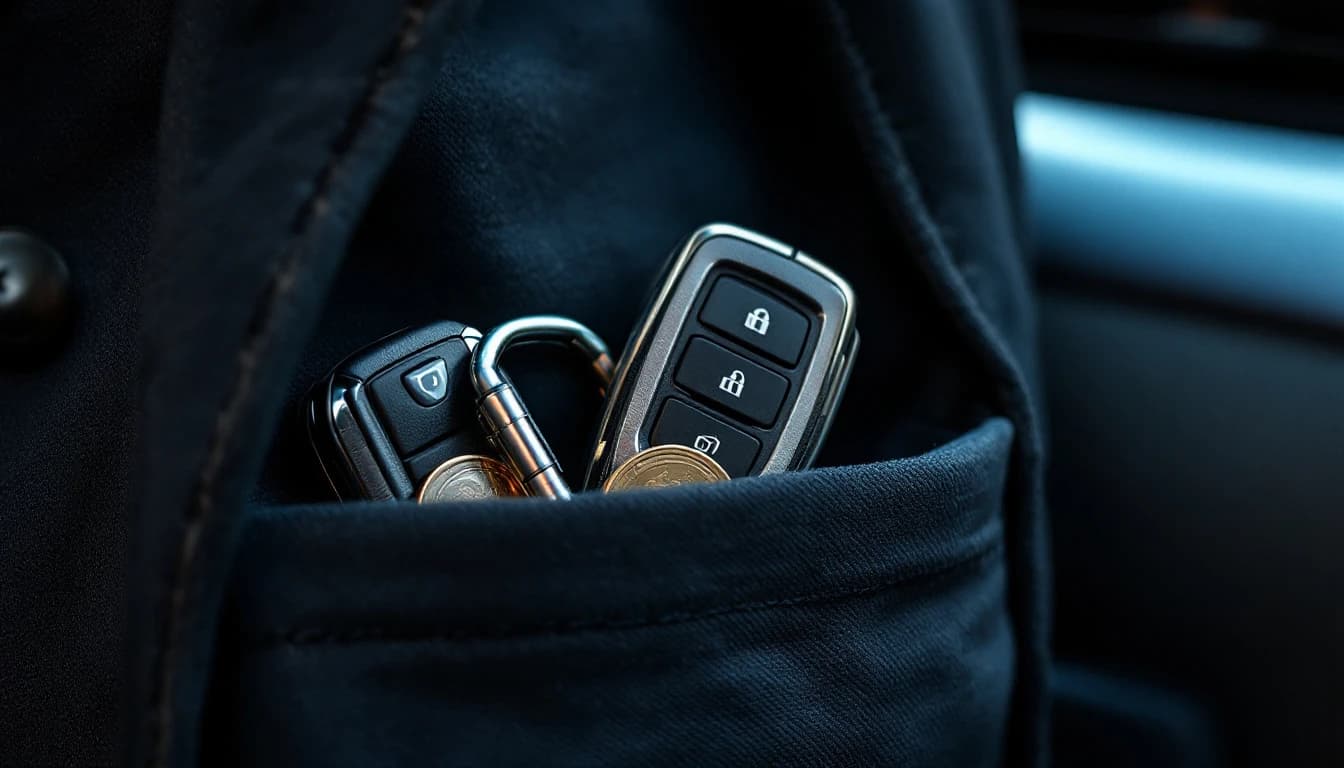
Your Car Locks and Unlocks Itself in Frisco, TX: Fob, Stuck Button or Door Module?
Car locking and unlocking by itself in Frisco, TX? How to tell a stuck fob button from a door latch or module fault, and what each costs. Call (469) 402-9781.
The Symptom
The doors lock and unlock without anybody touching anything. You hear the actuators thump in the garage at two in the morning. You press unlock, walk three steps toward the house, and the car re-locks behind you. The horn goes off in the driveway for nothing and the lights flash.
It feels like something exotic and expensive is wrong. It usually is not.
The short answer: isolate the fob. Put every fob you own inside the house, as far from the car as your property allows, ideally in a closed metal container, and leave the vehicle alone overnight. If the cycling stops, the problem is on the key side - a stuck button, a wet membrane, or a spare you had forgotten about sitting in radio range. If it continues with no fob near the car, the problem is in the vehicle - a door latch switch, a body or door module, or something aftermarket wired into the lock circuit. That one test splits the whole problem in half, and it costs nothing.
As of September 2026, across the calls we take in Frisco and the towns around it, this resolves to one of seven causes, and the first two account for most of them.
Frisco Car Key is a fully mobile automotive locksmith - we come to the car. Frisco Car Key, (469) 402-9781, contact@friscocarkeys.com.
Why This Is Worth Fixing Quickly
A car that unlocks itself is an open car. Not every cycle ends locked. If the last event of the night leaves the doors unlocked, you have a vehicle in a driveway with the garage opener, the registration and whatever is in the console available to anybody who tries the handle. Opportunistic vehicle entry is overwhelmingly a crime of unlocked doors, a point the National Highway Traffic Safety Administration makes repeatedly in its theft-prevention material, and the Insurance Institute for Highway Safety has documented how much modern anti-theft performance depends on a car's locking behavior working as designed.
Repeated cycling flattens the 12-volt battery. Lock actuators are motors. A car that cycles a few hundred times overnight wakes modules all night, and a tired battery will be flat by morning - which turns a nuisance into a no-start, and sometimes into a lockout, the locked-keys-in-the-car pricing conversation rather than this one.
The Causes, Ranked By How Often We Actually Find Them
1. A stuck or worn fob button
The most common answer by a wide margin. Three things make the membrane over the contacts fail into a permanent or intermittent press: pocket pressure (a fob under a phone or at the bottom of a bag gets its lock button pressed hundreds of times a day, and from thirty feet away in the garage every press reaches the car), wear (the dome collapses, so the contact stops separating - the tell is a button that feels mushy or needs no travel next to your spare), and water (a fob that went through a wash cycle rarely dies outright; moisture and residue bridge the contacts and it transmits on its own).
This ranks first on arithmetic: it is the only cause where a perfectly healthy car is doing exactly what it is being told.
2. A second fob nobody remembered
Every car came with two and households accumulate more. The spare is in a coat by the door to the garage, a drawer six feet from the interior garage wall, or a backpack in the entry hall - all well inside radio range of a car on the other side of one wall, and the pocket-pressure story then applies to a fob nobody is watching.
If both fobs started misbehaving at once, that is a different pattern, covered in both key fobs stopped working at the same time.
3. A failing door latch assembly or lock switch
Each latch holds small switches reporting door and lock state to the car. When one corrodes or wears it sends a changing signal the body module obediently acts on, completing a lock nobody asked for. Two tells point here: it follows one specific door being shut, or it follows weather - rain, heavy dew, a car wash. Water in a latch is a very common North Texas version of this.
This is mechanical door hardware, so plainly: latch and actuator replacement is not our trade. We diagnose it; a mechanic or body-electrical shop repairs it. Anyone who says a key or programming job fixes a bad latch switch is selling you something. A lock that physically will not move is the related symptom, covered in my car door lock is stuck.
4. A weak or dying 12-volt battery
Low voltage makes body electronics behave strangely. Modules brown out, reset and re-run their startup logic, and the result can be locks cycling, the alarm triggering, lights flickering or the horn sounding once for nothing. The confusing part is the loop: cycling drains the battery and a drained battery causes more cycling, so by the time somebody calls, cause and effect are tangled. That is why voltage goes early in the ladder despite not being the most common root cause - it is cheap to rule out and it contaminates everything downstream.
5. Passive entry and walk-up detection misreading
On a keyless car the door handles carry short-range antennas that unlock when they find a fob. Leave one on a garage shelf two feet from the driver's door and the car sits there finding and losing a key at the edge of range - unlocking, timing out, re-locking. Same physics as cause two, different mechanism: the car is interrogating the fob rather than the fob sending a press. The fix is free, which is another reason the isolation test belongs first.
6. A body control module or door module fault
Real, and the least common electrical cause. The body control module owns the doors, lights, horn and alarm, and a fault in its lock outputs or the door module it talks to makes the car act unprompted. This is a diagnosis of exclusion - only land here once the fob is provably out of the picture, every door checks out and the battery is healthy. When it genuinely is a module, the work sits in the ECU and module programming band, $200 to $800, plus the part. That job is described in our walkthrough of immobilizer module programming and on our ECU and module programming page.
7. Aftermarket equipment on the lock circuit
Remote start kits, add-on alarms, trackers and some insurance or fleet devices tap the lock wires, because that is how they lock the car after a remote start or arm themselves. A failing module, a chafed splice or a cheap relay in any of them will cycle your doors. One question usually resolves it: has anything been installed or hard-wired into this car in the last year? If the cycling started within a few weeks of that work, start there - far cheaper to test than a factory module diagnosis.
Symptom to Likely Cause
| What you are seeing | Most likely cause | Who fixes it |
|---|---|---|
| Cycling stops when all fobs are locked in the house | Stuck or worn fob button, or a forgotten spare | Locksmith, or free |
| Only when a fob sits a few feet from the car | Passive entry finding a key at the edge of range | Free - move the fob |
| Only after one specific door is shut | Latch or lock switch in that door | Mechanic or body-electrical shop |
| Worse in rain, dew or after a car wash | Water in a latch or a door connector | Mechanic or body-electrical shop |
| Locks cycle plus flickering lights or a random horn | Low 12-volt system voltage | Battery service or mechanic |
| Continues with every fob isolated, doors and battery fine | Body control or door module fault | Locksmith or dealer, after diagnosis |
| Started weeks after a remote start, alarm or tracker | Aftermarket module or splice on the lock circuit | Installer, or whoever wired it |
That is where to start looking, not a diagnosis. The ladder is how you narrow it.
The Diagnostic Ladder You Can Run Yourself
Cheapest and safest first, and each step is written so the result tells you something either way.
Step 1: Isolate every fob overnight
Gather every fob - yours, your spouse's, the drawer spare, the valet envelope - and put them all inside the house, as far from the car as possible, preferably in a closed metal container. Leave the car alone overnight. Cycling stops means it is a fob, so go to step 2. Cycling continues means every fob is provably out of the picture, so skip to step 5. This eliminates roughly two thirds of the possible causes in one night for free, so do it before anybody opens a door panel.
Step 2: Find out which fob
Bring back one fob and leave the rest isolated. Give it a day, then swap, noting which was out and what happened. If one fob only triggers it, that fob is the fault. If any fob triggers it, you are more likely in cause five - try a metal tin inside the house rather than a garage shelf and see whether that alone settles it.
Step 3: Inspect and reseat the guilty fob
Look at it in good light beside your spare and press each button on both. A lock button that needs noticeably less travel, feels mushy, or sits lower in the case is your answer. If it opens without tools, pull the coin cell for a minute, check for green or white residue on the board and contacts, and look for a torn or swollen membrane. Visible corrosion or a collapsed dome is a replacement, not a repair - either key duplication, $50 to $300, or a smart key, $120 to $500, and our smart key programming page explains which you are in.
Step 4: Change how you carry it, then re-test
Before buying anything, carry the fob on its own for two days - different pocket, not under a phone. Plenty of fobs that look faulty are simply being pressed. If that alone stops it, the fob is worn but working, and the right move is a spare made now while the original still functions rather than an emergency replacement later.
Step 5: Watch the car and write down the pattern
With the fobs isolated, pay deliberate attention for a few days. Does it happen at a consistent time, follow a specific door being shut, or track rain and humidity? Is the interior light or door-ajar indicator flickering at the same moment - because a door the car intermittently thinks is opening is a latch switch, more or less proven. Does the horn sound as well as the locks, since horn and lights together usually means the alarm is reacting to a door-state change rather than a lock command.
Step 6: Check 12-volt battery health properly
Not the dashboard, not a guess. Take a resting-voltage reading after the car has sat a few hours, or get a free load test at any battery counter. A battery reading low, or more than a few years old in this climate, is worth resolving before you chase modules. AAA has published for years on how much shorter real battery life runs in sustained heat, and North Texas summers are exactly that.
Step 7: Account for anything recently installed
Write down everything added in the past year - remote start, alarm, tracker, stereo, dash cam, amplifier, insurance dongle. If any of it lands near the date the cycling started, that install is your prime suspect and should be checked before a factory module is touched.
Step 8: Stop here and get it diagnosed
If the fobs are isolated, the doors and battery check out and nothing was installed, you have reached the end of the free steps. What remains is a latch switch you cannot see or a module, and both need equipment. This is the point to call - not three fobs ago.
What Each Outcome Actually Costs
We publish bands rather than one number because the job varies by platform, and any shop quoting one firm price for a car it has not seen has not diagnosed anything. The Federal Trade Commission treats quote-low-then-grow as a standing consumer-protection issue, and it is the most common complaint in this trade.
- Carry habit, a forgotten spare, or a fob too close to the car. Free. Most of these end here.
- Replacement basic remote or transponder key. Key duplication band, $50 to $300.
- Replacement proximity or push-to-start smart key. Smart key band, $120 to $500, confirmed against the VIN before we start.
- Door latch, lock actuator or door switch. Not our trade and we will not quote it.
- 12-volt battery. Battery service pricing, also not our trade.
- Body control or door module coding. ECU and module programming band, $200 to $800, plus parts, after diagnosis.
The honest split: the fob side is ours, the door hardware and the battery are not. We would rather tell you that on the phone than after you have paid us to show up.
When to Stop and Call
- It continues with every fob isolated. The decisive test pointed at the car, and further guessing costs more than diagnosis.
- The interior light or door-ajar indicator flickers with the cycling. A door is telling the car it is opening, and if it is the driver's door the alarm may be arming all night.
- The battery has gone flat once already. Two problems now feed each other, and the next flat battery may leave you locked out.
- The horn and lights are going off at night. An alarm firing unprompted means the car believes it is being entered.
- You bought the car recently and do not know its history. An unknown install, or unknown fobs in other people's hands, are both worth resolving.
- Anything is intermittent and you are about to start replacing parts. That is the expensive path.
Expect any legitimate operator to verify the car is yours - title or current registration against a government-issued photo ID - before touching keys or security modules. Secure vehicle security data is accessed through the framework maintained by the National Automotive Service Task Force, and the Associated Locksmiths of America lists willingness to skip that check as a leading red flag. In Texas, locksmith companies are licensed through the Texas Department of Public Safety Private Security Program - not the TDLR, a mistake that appears constantly in locksmith content online.
From a Recent Frisco Job
From a recent Frisco job (September 2026): a homeowner west of Preston Road called after four nights of the alarm going off between one and three in the morning. He had already replaced both fob batteries and had a quote in hand for a body control module. We asked him to do one thing before we came out - put both fobs in a cake tin on the kitchen counter, at the opposite end of the house from the garage, and text us in the morning.
Silent night. He put one fob back the next day and it started again within hours. That fob was the daily driver, carried in a front pocket under a phone, and its lock button had sunk below the surface of the case and needed no travel at all next to the spare. The membrane had collapsed. We made and programmed a new smart key and left the old one in a drawer as a lesson. The module quote was for a car that never had anything wrong with it, and he was two days from paying it.
How to Keep It From Coming Back
- Carry the fob on its own. Not under a phone, not at the bottom of a bag, not in a tight pocket you sit down in all day. That is the whole prevention plan for the most common cause.
- Keep spares away from the garage wall. A coat by the interior garage door and a drawer on the other side of it are both well inside range. A small metal tin is also the standard relay-theft precaution.
- Know how many fobs exist and where. If you bought the car used with one key, assume there may be others.
- Dry a wet fob properly and replace it if it starts acting up. A fob that swam usually fails weeks later, as this exact symptom.
- Do not let a marginal fob become your only fob. A spare made while the original works is cheap; one made after the last key dies is a different job at a different price.
- Watch the 12-volt on a car that sits. Weak batteries cause exactly this behavior.
We are fully mobile and cover Frisco and the surrounding communities, and we will talk through the isolation test on the phone before anybody pays for a visit.
Frequently Asked Questions
Why does my car lock and unlock by itself?
In most cases something is genuinely telling it to. The leading cause is a stuck or worn fob button - a fob pressed constantly in a pocket or bag, or one whose membrane has collapsed or been bridged by moisture. Second is a spare fob nobody remembered, sitting within radio range. After those come a failing door latch switch, low 12-volt voltage, a keyless system finding a fob at the edge of range, a body control module fault, and aftermarket equipment wired into the lock circuit.
How do I tell whether it is the fob or the car?
Lock every fob you own inside the house, far from the vehicle and ideally in a closed metal container such as a cookie tin, then leave the car alone overnight. If the cycling stops, it is a fob. If it continues with no fob near the car, it is the vehicle. That single free test eliminates roughly two thirds of the possible causes in one night, and it should come before anybody opens a door panel or quotes you for a module.
Is a car that unlocks itself a theft risk?
Yes, and that is the real reason to fix it rather than live with it. Not every cycle ends locked, so you can easily have a vehicle sitting overnight with the doors open to anybody who tries the handle, along with the garage opener and the registration. Opportunistic vehicle entry is overwhelmingly a crime of unlocked doors. The repeated cycling also runs the lock motors all night and will flatten a tired battery.
Can a dying 12-volt battery cause this?
It can. Low system voltage makes body electronics behave strangely - modules brown out and re-run their startup logic, which can show up as locks cycling, the alarm triggering, flickering interior lights or a single unexplained horn chirp. It is also self-reinforcing, because the cycling drains the battery further. Get a resting-voltage reading or a free load test early, since a weak battery contaminates every other diagnosis you try afterward.
Can you fix a bad door lock actuator or latch?
No, and we will say so plainly rather than sell you something. Latch assemblies, lock actuators and the switches inside them are mechanical door hardware, and that repair belongs to a mechanic or a body-electrical shop. We can tell you when the evidence points there - cycling that follows one specific door being shut, or that tracks rain and humidity, or that comes with a flickering door-ajar indicator. Anyone claiming a key job fixes a bad latch switch is not being straight with you.
How much does this cost to sort out in Frisco?
It depends which cause you have, which is why the free steps come first. Carry habit, a forgotten spare, or a fob left too close to the car cost nothing. A replacement basic remote or transponder key falls in our $50 to $300 duplication band. A replacement proximity or push-to-start smart key falls in our $120 to $500 smart key band, confirmed against your VIN before we start. Body or door module coding falls in our $200 to $800 programming band plus parts. Latch work and battery service are priced by a mechanic, not by us.
Could a remote start or alarm installation be causing it?
Very possibly, and it is worth checking early because it is cheap to test. Remote start kits, add-on alarms, trackers and some insurance or fleet devices tap directly into the lock and unlock wires, so a failing module, a chafed splice or a cheap relay in any of them will cycle your doors. The question that usually settles it is whether the cycling started within a few weeks of anything being installed or hard-wired into the car.
References
- National Highway Traffic Safety Administration (NHTSA) - vehicle theft prevention and anti-theft equipment guidance: https://www.nhtsa.gov
- National Automotive Service Task Force (NASTF) - secure vehicle security information and ownership verification: https://www.nastf.org
- Associated Locksmiths of America (ALOA) - consumer guidance on selecting and vetting a locksmith: https://www.aloa.org
- Insurance Institute for Highway Safety (IIHS) - vehicle theft and anti-theft technology research: https://www.iihs.org
- Federal Trade Commission (FTC) - consumer protection guidance on clear pricing and avoiding bait-and-switch: https://www.ftc.gov
- AAA - battery life in sustained heat and roadside preparedness: https://www.aaa.com
Doors cycling on their own in Frisco? Call Frisco Car Key at (469) 402-9781 or email contact@friscocarkeys.com. We will walk you through the overnight isolation test first - if it turns out to be free, we would rather tell you that than drive out.
Related Guides
Car Won't Turn Off in Frisco, TX: Push-Button and Key Ignitions Diagnosed
The engine keeps running after you press stop, or the key will not come back to off. A Frisco diagnostic guide to the causes - shifter, brake switch, start button, ignition switch, body module - in the order a technician checks them.
"Check Smart Key System" Warning on a Hyundai, Kia or Genesis in Frisco, TX
The message is specific to the Hyundai group and it rarely means the key itself is dead. A Frisco guide to what the Check Smart Key System warning actually points at - key, 12-volt, steering lock, smart key unit - and what each fix costs.
A Garage-Kept Exotic That Won't Wake Up for the Key in Frisco, TX
A car that sat for three months on a maintainer and now does nothing for the key. The owner's instinct is that the key died. It almost never is. Here is the order to check things in, and why improvised jump-starting is the expensive mistake.