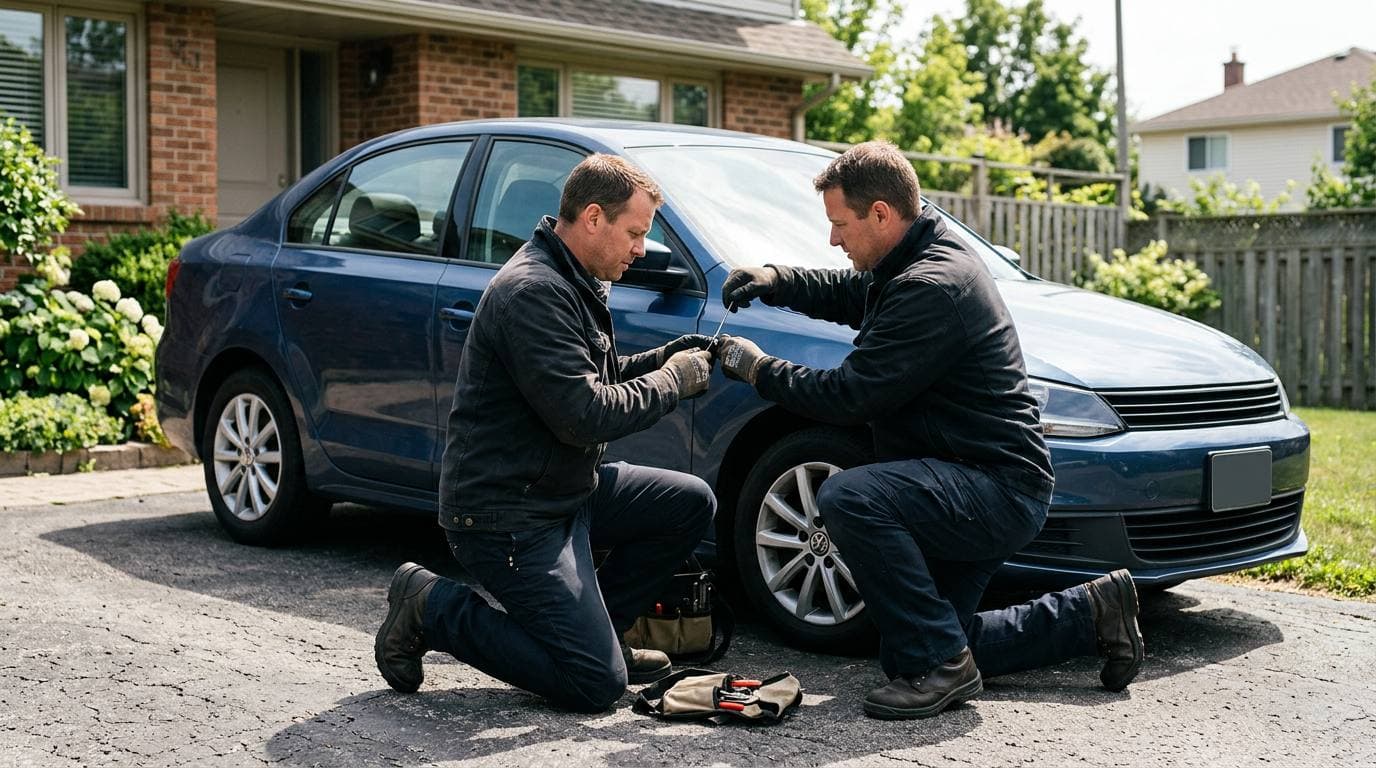
Key Turns But Steering Wheel Is Locked in Frisco
Explains why the key turns but the steering wheel is locked, what causes the steering-column pawl to stick, and which repairs free the wheel in Frisco.
Key Turns But Steering Wheel Is Locked in Frisco
When the key turns in the ignition but the steering wheel is locked and won't release, you're dealing with a mechanical steering-column lock that did not disengage properly—or an internal ignition cylinder or lock mechanism that has failed partway through its unlock sequence. Call or text (469) 402-9781 for mobile diagnostic and ignition repair service in Frisco, Plano, McKinney, and across Collin County. We bring dealer-level equipment to your driveway and handle both steering-lock faults and ignition-cylinder wear that prevents the lock from releasing.
This article explains why turning the key does not always free the steering wheel, what distinguishes a stuck steering lock from a worn ignition cylinder, and which fixes you can attempt yourself before calling for professional help.
Why the Steering Wheel Lock Engages Even When the Key Turns
Most vehicles use a spring-loaded pawl inside the steering column that engages a notched ring on the steering shaft whenever you remove the key and turn the wheel. The pawl drops into a notch, locking the wheel in place as an anti-theft feature. When you insert the key and rotate it to the ON or ACC position, a mechanical linkage—driven by the rotation of the ignition cylinder—is supposed to lift that pawl out of the notch and free the wheel.
When the key turns but the steering wheel is locked and won't release, one of three things has usually happened. The pawl did not fully retract because the ignition cylinder turned only partway, stopping short of the position that pulls the pawl clear. The linkage between the cylinder and the pawl has broken, worn, or become disconnected. Or the pawl itself is jammed by debris, corrosion, or a bent component inside the column.
In every case, the symptom is the same: the key rotates smoothly in the lock, the dashboard lights may illuminate, but the steering wheel will not budge. Forcing the wheel risks bending the pawl or damaging the column casting, so diagnosis comes before brute force.
The Difference Between a Steering Column Lock and an Ignition Lock
The ignition lock cylinder is the tumbler assembly you insert the key into; it contains spring-loaded pins that align when the correct key is inserted, allowing the cylinder to rotate. The steering column lock is a separate mechanical device—usually a steel pawl and spring mounted lower in the column—that the ignition cylinder controls through a rod or cable linkage.
On older vehicles, these two components are purely mechanical: turn the key, a rod pushes, the pawl lifts. On some newer cars—especially European luxury models—an electric actuator releases the steering lock after the immobilizer authorizes the key. That actuator can fail independently of the ignition cylinder, producing the same symptom: key turns, wheel stays locked.
Understanding this distinction matters because a mobile locksmith can rebuild or replace a worn ignition cylinder in your Frisco driveway, but a failed electric steering-lock actuator often requires dealer-specific tools to calibrate and pair to the vehicle's control modules. Nissan 370Z, Z, and Maxima Ignition Repair in Frisco, TX: Steering Lock, Dead Key, or Real Ignition Fault covers one common example where the electric lock motor fails outright, leaving the steering frozen even when the key and ignition work perfectly.
What to Try Before Calling for Help
If your key turns but the steering wheel is locked and won't release, start with the classic remedy: apply firm, steady pressure to the wheel in the direction it wants to turn while simultaneously rotating the key to the ON position. Do not yank the wheel or force the key; the goal is to relieve binding between the pawl and the notch so the linkage can pull the pawl free.
Try turning the wheel left, then right, while turning the key each time. If the pawl is only lightly engaged or sitting on the edge of a notch, this rocking motion can shift the load enough for the mechanism to unlock. Use your palm against the rim of the wheel—steady, sustained pressure—and turn the key with your other hand in one smooth motion.
If that fails, verify that the key is turning to the correct position. Some ignition cylinders have an ACC detent that feels like ON but does not fully rotate the cylinder far enough to retract the steering lock. Push the key in slightly and try rotating it one more click while holding wheel pressure.
Do not spray penetrating oil into the ignition cylinder or steering column; you may flush grease out of the lock mechanism and make the problem worse. Do not insert a screwdriver or pry tool into the column shroud; steering columns contain airbag wiring and delicate linkages that are expensive to replace.
When the Problem Is the Ignition Cylinder, Not the Steering Lock
If the key turns freely—too freely—without engaging any detents or resistance, the ignition cylinder wafers have worn to the point that the key no longer rotates the cylinder body. Instead, the key spins inside a worn tumbler, and the cylinder itself never moves. The steering lock never receives the mechanical input it needs to release.
This failure mode is common on high-mileage vehicles and any car with a single, heavily used key. The ignition cylinder contains spring-loaded wafers or pins that must align perfectly with the key's cuts. Years of insertion wear down the wafers and the keyway, allowing the key to turn without fully engaging the cylinder.
Toyota Camry & Corolla Ignition Repair in Frisco, TX: Worn Key or Worn Cylinder? explains how worn Toyota ignition cylinders produce exactly this symptom: the key rotates smoothly, but nothing happens because the internal wafers no longer transfer torque to the lock housing.
A mobile automotive locksmith can decode the existing cylinder, cut a fresh key to original factory depths, and—if the wafers are too worn—replace the cylinder with a new unit keyed to match your door locks. This work happens in your driveway and takes between one and two hours depending on the vehicle. Call or text (469) 402-9781 to confirm whether your specific make and model can be serviced on-site or requires dealer programming.
When the Problem Needs Dealer-Level Diagnostics
Certain vehicles use an electronically controlled steering lock that communicates with the body control module, immobilizer, and key fob before releasing the wheel. If the system does not recognize the key, the actuator motor will not run, and the steering stays locked—even if the physical ignition cylinder turns normally.
European luxury brands, including some BMW, Mercedes-Benz, Audi, Jaguar, and Land Rover models, use this architecture. The steering lock actuator is a sealed module mounted low in the column, and it requires bidirectional communication with the vehicle network to unlock. When the actuator fails, the car may log fault codes, illuminate the steering wheel warning lamp, or simply refuse to release the lock despite a valid key.
Porsche 911, Boxster & Cayman Ignition Switch Repair in Frisco, TX (1999-2012) describes similar electronic-lock issues on certain Porsche platforms, where the ignition switch and steering lock are separate modules that must be diagnosed individually.
A mobile locksmith with dealer-level scan tools can read the fault codes and determine whether the steering lock itself has failed, the key is not being recognized by the immobilizer, or the ignition switch is sending incorrect position signals. In many cases, the actuator can be replaced and recalibrated on-site. In others—especially if the body control module has flagged a tamper event or lost synchronization with the lock—the vehicle will need towing to a dealer for module reprogramming.
We are upfront about which jobs belong in your driveway and which belong at the dealer. Texas locksmith companies and technicians must follow state licensing and vehicle-ownership verification requirements. Reputable automotive locksmiths should be able to show business identification, insurance, and proof of authorization before performing vehicle key work.
Steering Lock Release Versus Ignition Cylinder Replacement
The table below summarizes the two most common failure modes and their typical resolutions.
| Symptom | Likely Cause | Typical Fix | Mobile Service? |
|---|---|---|---|
| Key turns smoothly, wheel locked, dashboard lights on | Pawl linkage disconnected or pawl jammed | Steering column disassembly, linkage repair or pawl replacement | Yes, if mechanical; dealer if electronic actuator |
| Key turns with no resistance, wheel locked, no dash response | Worn ignition cylinder wafers; cylinder spins without engaging lock body | Ignition cylinder replacement, new key cut to code | Yes, unless paired to immobilizer requiring dealer scan tool |
| Key recognized, dash lights on, steering will not unlock, warning lamp lit | Electronic steering lock actuator fault or module communication error | Actuator replacement and calibration, possible module reprogram | Depends on fault codes; mobile diagnosis, possible dealer tow |
If you are unsure which category your vehicle falls into, a mobile diagnostic visit can identify the fault without the cost or delay of a tow. We bring factory-level scan tools to your location in Frisco, read live data from the steering-lock module and ignition switch, and provide a written estimate before starting any repair.
How Mechanical and Electronic Locks Fail Differently
Mechanical steering locks fail from wear, corrosion, or physical damage. The pawl spring weakens, the linkage rod bends, or the pivot bushing wears oval, allowing the pawl to stick in the locked position even when the cylinder rotates. These faults develop gradually and often produce intermittent symptoms—sometimes the wheel unlocks, sometimes it does not—before failing completely.
Electronic steering locks fail suddenly. The actuator motor burns out, the control module loses power or ground, or a software glitch prevents the unlock command from reaching the actuator. There is rarely any warning; the car works one day and will not unlock the next.
Both failure types can strand you, but the diagnostic path differs. A mechanical lock can be manually released in an emergency by disassembling the lower column shroud and lifting the pawl with a pick or small screwdriver—a task best left to a locksmith, because the airbag clockspring and turn-signal stalk sit immediately above the lock assembly and are easy to damage. An electronic lock cannot be manually bypassed without triggering tamper flags in the body module, so diagnosis and proper repair are the only safe options.
Jeep Grand Cherokee & Dodge Durango Ignition Repair in Frisco, TX discusses similar ignition and lock issues on Stellantis platforms, where a worn ignition switch can prevent the steering lock from receiving the unlock signal even when the cylinder itself still turns.
Frequently Asked Questions About Steering Wheel Lock Issues
Can I drive with the steering wheel locked if the engine starts?
No. Even if the engine runs, a locked steering wheel makes the vehicle impossible to steer and unsafe to operate. Do not attempt to drive; the wheel will not turn, and you risk losing control.
Why does turning the wheel and key together sometimes work?
Turning the wheel relieves binding between the steering-lock pawl and the notch in the steering shaft, allowing the pawl to retract when the ignition cylinder pulls on the linkage. The technique works when the pawl is lightly engaged but fails if the linkage is broken or the cylinder is worn.
Will replacing the ignition cylinder fix the steering lock?
Only if the cylinder is so worn that it no longer rotates far enough to activate the lock mechanism. If the pawl itself is jammed or the linkage is broken, you will also need steering-column repair.
How long does steering lock repair take?
Mechanical steering-lock repair in the column typically takes one to two hours once the vehicle is accessible. Electronic actuator replacement and calibration can take two to three hours depending on the module-pairing procedure.
Can a locksmith fix an electronic steering lock in my driveway?
In many cases, yes—if the fault is the actuator itself and the vehicle does not require dealer-only software to pair the new unit. A scan-tool diagnostic will confirm whether on-site repair is possible or a dealer visit is required.
Get Help with Ignition and Steering Lock Problems in Frisco
When the key turns but the steering wheel is locked and won't release, you need diagnosis before you need parts. We bring factory scan tools, ignition-cylinder service kits, and years of hands-on experience with European, domestic, and Asian steering-lock systems to your home, office, or roadside location in Frisco and throughout North Texas.
Mobile locksmith service is often faster and more convenient than the dealership because we come to your location, help avoid towing, and can complete many ignition repairs the same day. Arrival time depends on technician availability, traffic, and your exact location. We provide upfront, transparent estimates based on the actual fault codes and visible wear—no fabricated quotes, no upsells.
Call or text (469) 402-9781 to schedule a mobile diagnostic visit or request a quote for ignition and steering-lock repair in Frisco, Plano, McKinney, Prosper, Little Elm, The Colony, or surrounding Collin County communities. Our team will verify vehicle ownership, explain what the repair involves, and complete the work in your driveway whenever parts and programming allow—or provide honest guidance if your vehicle requires dealer-level service.
Related reading
Related Guides

Can You Rekey a Luxury Car Ignition Cylinder to a New Key?
Rekeying a luxury car ignition cylinder is sometimes possible for older models, but modern vehicles with electronic immobilizer systems require reprogramming…
Hyundai and Kia Spare Key Cost in Frisco, TX (2026): By Key Type, Not Just Model
A spare Hyundai or Kia key is priced by the kind of key, not the badge. Here is what a spare costs in Frisco for turn keys, flip keys, smart keys and digital keys, and the one rule that saves owners the most money.

Kia K4 Key Replacement in Frisco, TX: Smart Key, Spare Key and Digital Key 2
The Kia K4 replaced the Forte with a more connected key setup. Here is how the K4 smart key works, what a spare or replacement costs in Frisco, where Digital Key 2 fits, and how to avoid the expensive all-keys-lost visit.