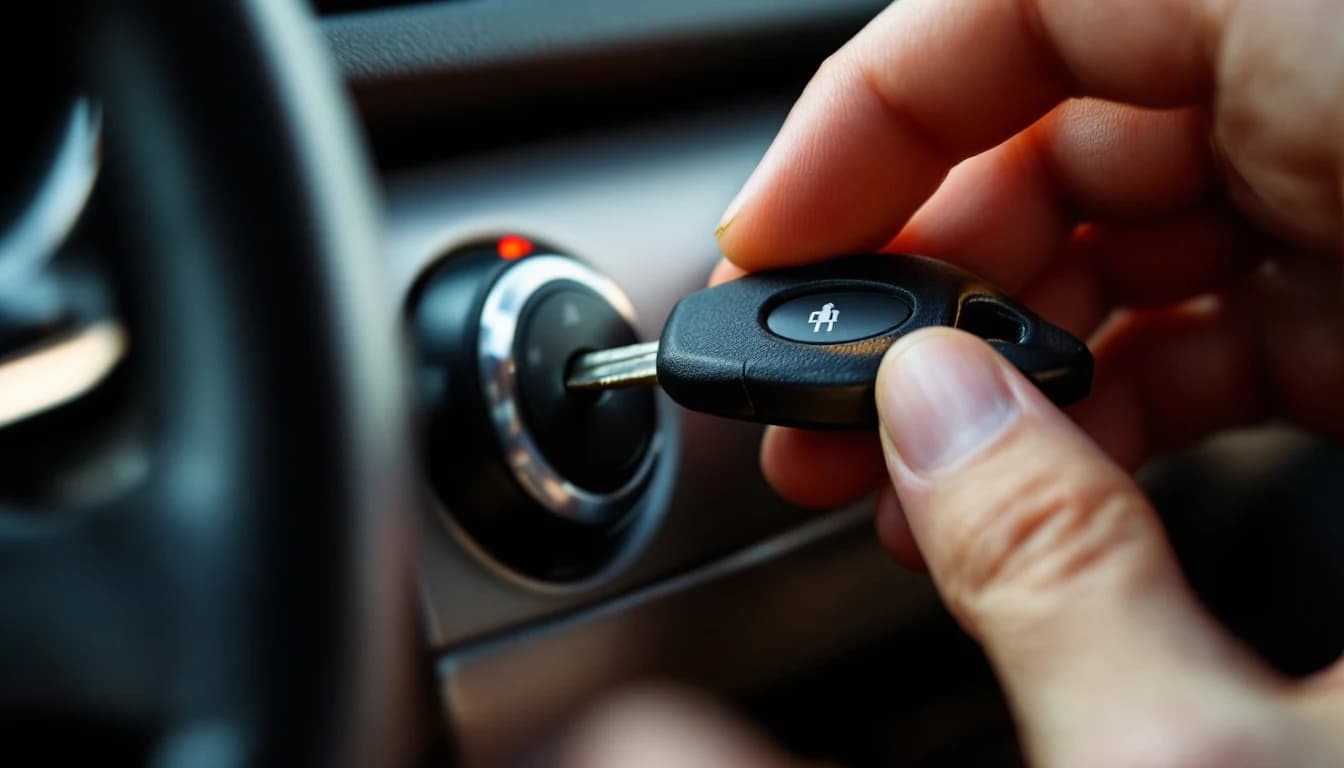
Toyota Camry & Corolla Ignition Repair in Frisco, TX: Worn Key or Worn Cylinder?
2026 Toyota Camry & Corolla ignition repair in Frisco, TX. Worn key vs worn lock cylinder diagnosis, honest price ranges. Call (469) 402-9781.
Toyota Camry and Corolla Ignition Repair in Frisco, TX
Toyota built its reputation on parts that do not break, and the ignition lock cylinder in a Camry or a Corolla is a good example of that engineering. These cylinders routinely survive fifteen years and a quarter million cycles without complaint. Which creates a specific and useful diagnostic insight: when a Camry or Corolla key stops turning smoothly, the odds strongly favor the key having worn out rather than the lock.
That distinction is worth real money. A key cut to the vehicle's factory code is one of the least expensive services we perform. Replacing an ignition lock cylinder is several times that. Getting the diagnosis right is the single biggest lever on what this repair costs you, and it takes about ten minutes in your driveway.
Frisco Car Key is a fully mobile automotive locksmith. There is no shop to drive to, which matters when the car in question will not start. As of August 2026, Camry and Corolla ignition calls are a weekly fixture for us across Frisco, Plano, and McKinney, and the vast majority resolve without replacing a single hard part. Call or text (469) 402-9781 to start with a diagnosis.
Quick Answer
If your Toyota Camry or Corolla key will not turn, try three things before assuming the cylinder is bad. First, rock the steering wheel firmly left and right while applying light, steady turning pressure to the key, because a loaded steering lock pin binds the cylinder. Second, try a spare key that has lived in a drawer rather than a pocket, since a low-wear key will reveal whether your daily key is simply worn down. Third, confirm the shifter is genuinely and fully in Park. If a drawer key turns normally and your everyday key does not, you need a new key cut to the factory code, not an ignition repair. If both keys fail identically, the cylinder itself has worn and needs service. Mobile ignition work in Frisco runs $150 to $550; a fresh key runs $85 to $450.
Frisco Pricing for Toyota Ignition and Key Work
Ranges below are honest bands current as of August 2026, not quotes. Your firm number follows an on-site diagnosis and VIN confirmation.
| Toyota Camry / Corolla Scenario | Typical Range | Notes |
|---|---|---|
| On-site ignition diagnosis | Included in service call | Separates worn key from worn cylinder |
| Key cut to factory code and programmed | $85-$450 | The fix for most no-turn complaints |
| Spare key duplication from a working key | $50-$300 | Cheapest insurance available |
| Ignition lock cylinder service or replacement | $150-$550 | When both keys fail identically |
| Smart key / push-button fob replacement | $120-$500 | Higher trims without a rotating ignition |
| Immobilizer or module programming | $200-$800 | Only when the fault is electronic |
| Lockout, keys locked inside | $75-$200 | Damage-free entry, no ignition work |
We publish ranges rather than a headline price because a Corolla key cut to code and a Camry cylinder replacement are not comparable jobs. The Federal Trade Commission advises consumers to require itemized estimates before authorizing automotive work, and a diagnosis-first approach is how you get one that means something.
How the Toyota Ignition System Actually Works
Two things happen simultaneously when you turn a Camry or Corolla key, and understanding the split explains nearly every symptom you can experience.
The Mechanical Half: The Lock Cylinder
Inside the ignition lock sits a stack of spring-loaded wafers. The cuts along your key blade push each wafer to a precise height. When every wafer lines up on the shear line at once, the cylinder is free to rotate. Rotate it, and a mechanical coupling drives the electrical ignition switch mounted behind the lock housing, which is what actually sends power to accessories, the run circuit, and the starter.
Toyota's wafer stacks are well made and generously toleranced, which is why they last. But the tolerance is not infinite. Two decades of insertions gradually round the wafer edges and polish the key blade, and eventually the key no longer lifts the wafers to precisely the right heights.
The Electronic Half: The Transponder and Immobilizer
Separately, an antenna coil wrapped around the ignition lock housing energizes a passive transponder chip inside the head of your key. The chip answers with a coded response. The vehicle's immobilizer checks that response against what it has stored and either authorizes the engine or refuses. Toyota adopted transponder immobilizers broadly across the Camry and Corolla lines, and later generations use more sophisticated rolling-code chips than the early ones.
This half never affects whether the key turns. It only affects whether the engine runs. That single fact resolves more Toyota misdiagnoses than any other piece of knowledge in this article.
The Push-Button Generations
Higher Camry and Corolla trims moved to Smart Key proximity systems with a push-button start and no rotating ignition at all. On those vehicles there is no cylinder to wear out, so a no-start complaint moves entirely into the electronic domain: fob battery, fob detection, the start-stop switch itself, or the immobilizer. There is still a mechanical emergency blade hidden inside the fob for the driver's door, and a documented backup method for starting with a dead fob battery. If your Camry or Corolla is push-button, the entire "worn cylinder" branch of this article does not apply to you, and we would move straight to smart key programming diagnostics instead.
Common Toyota Ignition Problems We See
The key needs wiggling and it is getting worse. By far the most common Camry and Corolla complaint, and by far the most likely to be a worn key rather than a worn lock. The progression is slow and predictable: first it needs a slight jiggle occasionally, then every time, then only in one particular position, then not at all.
The key will not turn and the steering wheel is under tension. If you parked with the wheels turned against a Frisco curb or on a crowned residential street, spring pressure loads the steering column lock pin against the cylinder. This is not a failure. Rock the wheel while applying light turning pressure and it releases.
The key turns but the engine cranks without starting, and a security light is on. Immobilizer territory, not ignition territory. The cylinder did its job by rotating. The chip, the antenna ring, or the module is the issue. Replacing a lock cylinder here would change nothing.
The key will not come out. On a rotating ignition this usually means the shifter is not fully seated in Park, or the interlock that gates key removal has failed. It is genuinely worth pushing the shifter firmly into Park and trying again before calling anyone.
Nothing electrical happens at any key position. If the dash stays completely dark through all key positions, the fault may sit in the electrical ignition switch behind the cylinder rather than in the lock itself. Those are different parts with different labor, and telling them apart is part of what a diagnosis buys you.
Heavy keychain damage. A Camry ignition supporting a fistful of house keys, gym fobs, and a bottle opener spends years absorbing a lever load it was never designed for. The American Automobile Association has recommended lightweight key rings for decades, and Toyota columns are a case study in why.
"On a Toyota, I start with the assumption that the cylinder is fine, because usually it is. I look at the key first, then the door lock for comparison, then the steering lock. By the time I have done those three checks I already know whether this is a forty-dollar problem or a four-hundred-dollar problem, and the customer knows too, before I quote anything." - a Frisco Car Key mobile locksmith technician credentialed for automotive immobilizer work
The Worn-Key Versus Worn-Cylinder Diagnosis, Done Properly
This is the heart of the article. Four checks, in order.
Check One: The Drawer Key
Find the spare that came with the car and has been sitting in a kitchen drawer since the day you bought it. That key has almost zero wear. Try it in the ignition.
If it turns smoothly while your everyday key struggles, the diagnosis is finished. The cylinder is healthy and your daily key has simply eroded. A new key, cut to code, solves it permanently.
If the drawer key struggles exactly the same way, the wear is in the lock, not the key, and cylinder service is warranted.
This one test resolves the majority of Camry and Corolla ignition calls, and it costs nothing.
Check Two: The Door Lock Comparison
Toyota typically keys the driver's door cylinder and the ignition to the same code from the factory, but the ignition sees an order of magnitude more use. If your key snaps the driver's door cylinder crisply through both directions while fighting the ignition, that asymmetry is meaningful evidence for ignition wear specifically. If the key is sloppy in both, the key is the common denominator.
Check Three: Visual Key Wear
Lay your key next to a spare, or next to a photo of a factory-fresh blade. Worn keys show rounded peaks where crisp valleys should be, and a visibly polished, thinned profile along the blade. A key that has lost even a few thousandths of an inch across several cuts is no longer lifting wafers to the correct heights.
Check Four: Never Copy a Worn Key
This is the mistake that quietly wastes the most money. Duplicating a worn key at a kiosk copies the wear into the new blank. You get a brand-new key that is born already worn out, the problem returns within weeks, and now you believe the cylinder must be bad because "even a new key does not work."
The correct approach is to cut to the vehicle's original factory code, which we can derive from the vehicle rather than from your worn key. A code-cut key comes out at full factory dimension. On a marginal cylinder that alone frequently restores completely normal operation. Both our car key replacement and key duplication services are built around that distinction.
When It Really Is the Cylinder
If both keys fail identically and the door lock works fine, the ignition cylinder has worn past its usable range and needs service or replacement. On Camry and Corolla columns this is a well-understood job. Where the design allows, we can key the replacement cylinder to your existing key so you do not end up carrying two different keys for one car. Where the design does not allow it, you receive keys cut and programmed to the vehicle as part of the work, and we tell you that before we start rather than after.
Occasionally the fault is the electrical ignition switch behind the cylinder rather than the lock itself. The symptom that points there is an absence of electrical response at key positions that should produce one, rather than a mechanical refusal to turn. That is a different part and a different quote, and honest diagnosis distinguishes the two.
Our ignition repair page covers the full scope of what we handle on-site. For a look at how a closely related Toyota-family column behaves, our guide to Lexus RX and ES ignition switch repair walks through the same diagnostic logic on the luxury side of the house, and our Toyota RAV4 and Prius key replacement guide covers the key side for Toyota's other high-volume models in North Texas.
The Honest Boundary
We will not sell you a cylinder because it is the bigger ticket. If a code-cut key fixes your Camry, that is what we will recommend, and it is the smaller invoice.
We also will not blur what module work means. Programming a key into an existing immobilizer is not the same as replacing an immobilizer module, and neither is the same as replacing an ignition cylinder. Those are three distinct jobs at three distinct price points, and any shop that describes them interchangeably is either careless or hoping you will not notice.
On the newest Toyota platforms, security access is increasingly gated through manufacturer-sanctioned channels. The National Automotive Service Task Force provides the legitimate route by which vetted independent technicians obtain security information where a manufacturer supports it. Where that path exists we can work, and where a particular vehicle genuinely requires the dealer we will tell you plainly rather than attempt something we cannot finish. On the newest cars a technician confirms your exact setup after VIN before we commit to a same-visit result.
Why Toyota Owners Should Care About This Now
The economics favor acting early in a way that is unusual among car repairs. An ignition that needs jiggling is not going to heal. It is going to keep degrading on a curve, and the endpoint is a car that will not start on a morning you cannot afford it. The repair costs the same next month as it does today, but the circumstances will be worse.
There is also a security dimension. The National Highway Traffic Safety Administration has documented how dramatically transponder immobilizers cut drive-away vehicle theft, and the Insurance Institute for Highway Safety has published parallel findings across the industry. Toyota's immobilizer implementation is a genuine anti-theft asset. The tradeoff is that when a transponder or antenna misbehaves, the car protects itself by refusing to start, which from the driver's seat looks identical to a failure. Understanding that your ignition has a mechanical half and an electronic half is what keeps you from paying to fix the wrong one.
Serving Frisco and Nearby North Texas
We are mobile, so we come to your house, your office parking garage, or wherever the Camry decided to stop cooperating. We serve Frisco, Plano, McKinney, Allen, The Colony, and Prosper. Learn more about our team or contact us to schedule.
In Texas, locksmith and access-control companies operate under the Texas Department of Public Safety Private Security Program. We verify vehicle ownership before performing key or ignition work, a practice the Associated Locksmiths of America treats as fundamental to the profession.
Frequently Asked Questions
Why won't my Toyota Camry key turn in the ignition?
Four causes account for nearly all cases: a worn key, a steering column lock binding under wheel tension, a shifter not fully seated in Park, and a genuinely worn ignition lock cylinder. On a Toyota specifically, worn keys are far more common than worn cylinders because Toyota's cylinders are unusually durable. Rock the steering wheel while applying light turning pressure, confirm Park, and try a spare key that has not been carried daily before assuming the lock has failed.
How do I tell whether my key or my ignition cylinder is worn out?
Try a spare key that has lived in a drawer. If the drawer key turns smoothly and your pocket key does not, your daily key has worn down and a new key cut to the factory code fixes it. If both keys behave identically, the cylinder is worn. A second useful check is the driver's door lock: if the key operates the door crisply but fights the ignition, the ignition has taken far more cycles and is the worn component.
Why shouldn't I just copy my existing Toyota key?
Because duplicating a worn key copies the wear. The new key emerges already at the end of its usable life, the symptom returns within weeks, and you may wrongly conclude the cylinder is bad. The correct method is cutting to the vehicle's original factory code, which produces a key at full factory dimension. On a marginal ignition that alone frequently restores normal operation without touching the lock.
How much does Toyota ignition repair cost in Frisco?
As of August 2026, ignition cylinder service or replacement runs $150 to $550 in our service area. A key cut to code and programmed runs $85 to $450, and duplicating a spare from a good original runs $50 to $300. Because the worn-key diagnosis so often applies to Camrys and Corollas, many customers who expect a cylinder bill end up paying for a key instead. We diagnose on-site and quote before any work.
My Camry has push-button start. Does any of this apply?
The mechanical portion does not, because there is no rotating ignition lock to wear out. On Smart Key Camrys and Corollas a no-start is an electronic question: fob battery, fob detection, the start-stop switch, or the immobilizer. There is still an emergency blade inside the fob for the driver's door and a documented backup starting method for a dead fob battery. Those vehicles route to smart key diagnostics rather than ignition repair.
The key turns fine but the engine won't start and a light is flashing. What is that?
That is the immobilizer, not the ignition. The key rotating proves the mechanical lock is working. The flashing security indicator means the vehicle is not authorizing the engine, which points at the transponder chip in the key head, the antenna ring around the lock, or the security module. Replacing an ignition cylinder would not help, and any shop suggesting it has skipped the diagnosis.
Can you do all of this at my house in Frisco?
Yes. We are fully mobile with no storefront, which is the point: a car that will not start cannot come to us. We cut keys to code, program transponders, and service ignition cylinders on-site across Frisco and the surrounding communities. Tell us the year, model, whether you have a working spare, and exactly what the key does, and we will arrive with the right tools rather than making a second trip.
Get Your Camry or Corolla Ignition Fixed in Frisco
Frisco Car Key diagnoses first and quotes second, which on a Toyota usually means you pay for a key rather than a cylinder. Call or text (469) 402-9781 or email contact@friscocarkeys.com with your year, model, and a description of what the key does. Mobile service across Frisco and North Texas, honest ranges, and no upsell to a part you do not need.
References
- National Highway Traffic Safety Administration (NHTSA) - immobilizer technology and vehicle theft prevention: https://www.nhtsa.gov
- National Automotive Service Task Force (NASTF) - secure vehicle access for independent technicians: https://www.nastf.org
- Associated Locksmiths of America (ALOA) - professional locksmith standards: https://www.aloa.org
- Insurance Institute for Highway Safety (IIHS) - anti-theft effectiveness research: https://www.iihs.org
- Federal Trade Commission (FTC) - consumer guidance on repair estimates and pricing: https://www.ftc.gov
- AAA - driver guidance on key care and roadside services: https://www.aaa.com
Related Guides

Push-Button Start Stuck in Accessory Mode: Causes, Checks and Cost in Frisco, TX
The dash lights up, the radio plays, and the engine never starts. A diagnostic walkthrough of why a push-button car stops at accessory mode, what each cause costs to fix, and who to call.
Kia K5 and Stinger Ignition Repair in Frisco, TX: Key, Switch, or Steering Lock?
A Kia K5 or Stinger that will not crank is usually one of four separate faults, and only some of them are key problems. Here is how a mobile locksmith tells them apart in a Frisco driveway.
Nissan 370Z, Z, and Maxima Ignition Repair in Frisco, TX: Steering Lock, Dead Key, or Real Ignition Fault
A Nissan that clicks, flashes a steering lock warning, and refuses to start is usually one of three separate faults. Here is how to tell an electronic steering lock failure from a dead Intelligent Key or a genuinely worn ignition, and what a mobile locksmith can fix on site.