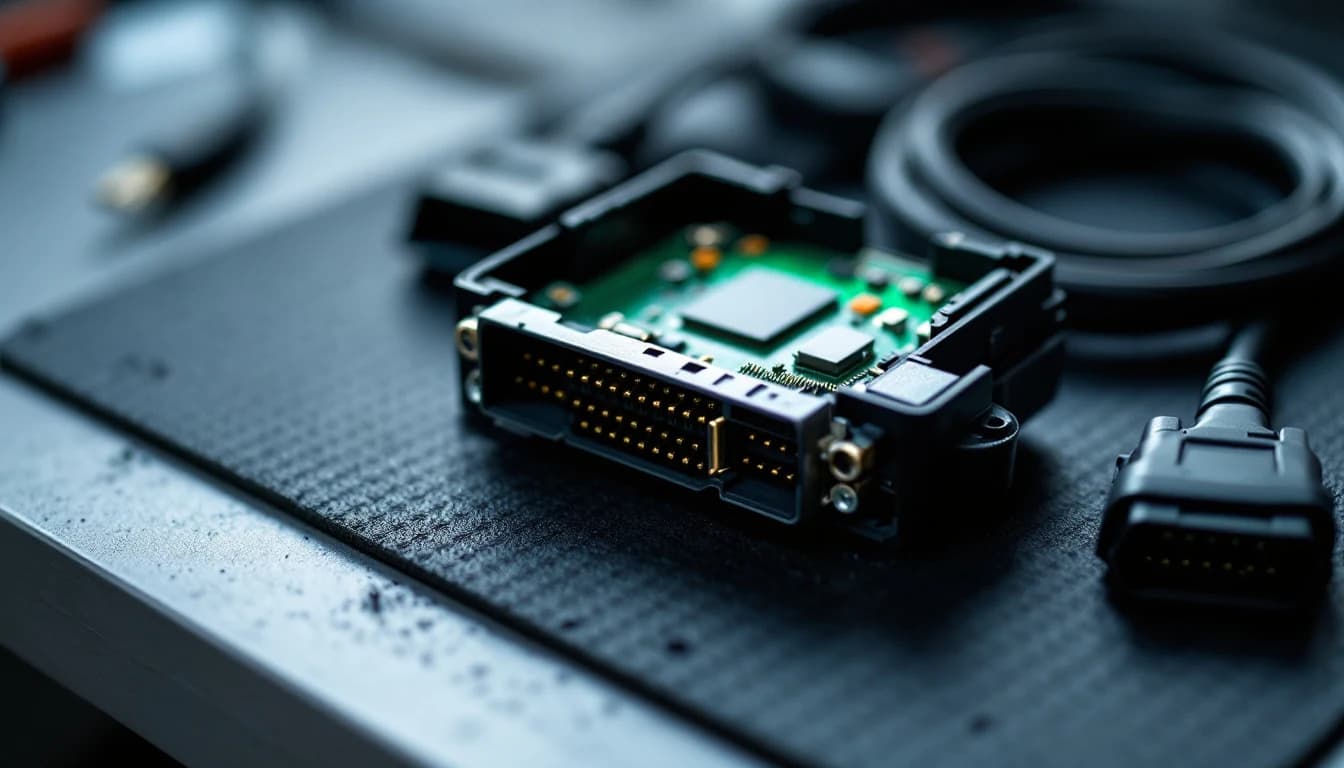
Mercedes-Maybach & S-Class Module Programming in Frisco, TX: EIS, ESL, and VIN Coding
2026 Mercedes-Maybach and S-Class module programming in Frisco, TX. EIS, ESL, FBS coding to VIN, honest dealer boundaries. Call (469) 402-9781.
Mercedes-Maybach and S-Class Module Programming in Frisco, TX
As of August 2026, module and ECU programming work on a Mercedes-Benz S-Class or Mercedes-Maybach in Frisco falls in the $200 to $800 band, and the honest qualifier that belongs in the same sentence is that not every module job on these cars can be completed outside the dealer. Frisco Car Key is fully mobile, so where the work is serviceable we do it where the car is parked. Where it is not, you get told that during phone triage instead of after a trip charge.
This guide explains the actual mechanism: what the EIS is, what the ESL does, why a replacement module has to be cryptographically married to your VIN before the car will acknowledge it, and why so many owners who bought a used module from an online seller end up worse off than when they started. It is written for the person who has already been told "you need a new module" and wants to understand what that actually means before authorizing anything. Reach us at Frisco Car Key, (469) 402-9781, contact@friscocarkeys.com.
The EIS: The Module Everything Else Answers To
Nearly every Mercedes immobilizer conversation starts and ends with one component.
Mercedes-Benz uses an electronic ignition switch module, called the EIS in English documentation and the EZS in German. On an S-Class or Maybach it is the security gatekeeper for the whole vehicle. It stores the cryptographic relationship between the car and every key authorized to operate it. It communicates with the engine control unit and the transmission control unit to decide whether the car may start and move. On push-button cars it houses the start logic. On models with an electronic steering lock, it governs that too.
The design philosophy is centralization: concentrate the authority in one hardened module, harden that module thoroughly, and the rest of the car becomes far less attractive to a thief. The National Highway Traffic Safety Administration has documented how immobilizer adoption collapsed drive-away theft rates across the industry, and Mercedes built one of the more centralized versions of the concept.
The consequence for service is direct. You cannot simply install a working EIS from another car. The module carries data specific to the vehicle it came from, and the target vehicle's other control units will refuse to cooperate with a module they do not recognize. This is the single most common misunderstanding we correct on the phone, and it is the reason a bargain module from an auction listing so frequently becomes an expensive lesson.
"Owners bring me a used module and ask me to just plug it in. I understand why it seems like it should work, because mechanically it fits perfectly. But the car is not looking at the connector, it is looking at the cryptographic identity, and that identity belongs to a different VIN. Coding it correctly is the entire job, and on the newest cars that coding step is not mine to perform." - a Frisco Car Key mobile locksmith technician credentialed for automotive immobilizer work
The ESL: The Electronic Steering Lock and Why It Strands Cars
The second component owners encounter, usually at the worst possible moment, is the ESL, the electronic steering lock. On the Mercedes models that use it, the ESL replaces the old mechanical steering column lock with a motorized, electronically commanded mechanism. The EIS tells the ESL to release when an authorized key is validated.
That works beautifully until the ESL, or the communication path to it, fails. The symptom is unmistakable and alarming: the key is recognized, the dash may light up, and the steering wheel simply stays locked while the car refuses to start. Owners reasonably assume the key has failed. It usually has not.
What matters for a Frisco owner facing this:
It is a genuine immobilization event, not a nuisance. The car will not move under its own power with the steering locked, so this is one of the failure modes that reliably produces a tow if it happens away from home.
It is a module problem, not a key problem. Replacing the key does nothing. Diagnosis has to establish whether the fault is in the ESL itself, in the EIS commanding it, or in the communication between them.
The repair path is generation-dependent. On some architectures, an ESL-related repair with proper coding is achievable by a credentialed independent. On the newest cars it is not, for the same authorization reasons that govern key generation.
Anyone who quotes an ESL job on a Maybach sight-unseen, over the phone, without asking for the VIN, is quoting a guess.
FBS Generations in Plain English
Mercedes refers to its drive authorization system by an abbreviation you will encounter if you research this yourself: FBS, from the German for drive authorization system. Over the years Mercedes has iterated through several generations of it, each one tightening the cryptography and narrowing the ways a new key or module can be authorized.
You do not need the engineering detail. You need the shape of the curve, which is simple and consistent:
Older FBS generations. Well-established, legitimate independent service paths exist for many key and module scenarios. A credentialed locksmith with proper equipment and authorization can often complete the work.
Middle generations. Mixed. Some operations remain independently serviceable, others begin requiring manufacturer resources. VIN-level verification genuinely matters here, because two cars of the same model year can differ.
The newest generation, commonly called FBS4. Key generation and module authorization are manufacturer-controlled. On these cars, the honest answer for most key and immobilizer-module work is the dealer. Not because independents lack ambition or tooling budget, but because the authorization step happens inside a system Mercedes controls.
The National Automotive Service Task Force exists precisely to give vetted independent locksmiths a legitimate channel for secure vehicle information and access on makes and models that support it. Where Mercedes supports that channel for your specific vehicle, a credentialed independent can help. Where the manufacturer has reserved the operation, the dealer is the correct and sometimes only route, and pretending otherwise costs owners money.
The same discipline applies to every ultra-luxury vehicle we touch, whether that is a Maybach in a gated Frisco neighborhood or the Aston Martin service in Frisco we handle for the same clientele: identify the platform generation, state the boundary honestly, and quote only what can genuinely be delivered.
Why a Replacement Module Must Be Coded to Your VIN
This is worth spelling out, because it explains almost every failed DIY attempt we get called about afterward.
A modern control module ships or arrives in one of three states.
Virgin or blank. The module has never been married to a vehicle. This is the cleanest starting point, because the coding process can write your vehicle's identity into it. Virgin modules are not always available and are typically the most expensive option.
Used and still married to its donor. The module physically fits your car and electrically connects fine, but it carries the identity of the vehicle it was removed from. Your car's other control units will not accept it. Depending on the platform, it may be possible to reset or renew the module, or it may be permanently locked to the donor VIN. On newer cars, permanently locked is the common outcome.
Refurbished or renewed by a specialist. A third party has reset the module to an accepting state. Quality varies enormously across vendors, and a poorly renewed module can waste an entire appointment.
Coding, in this context, means writing your VIN and configuration into the module and then getting the other control units on the vehicle network to accept the new participant. On an S-Class or Maybach that network is large, with the EIS, engine control unit, transmission control unit, body electronics, and comfort systems all needing a consistent view of the car.
Which is why a used module is usually a false economy. The purchase price is a fraction of the total, and if the module cannot be legally and technically coded to your car, the purchase price is the total loss. We have this conversation weekly. The same pattern shows up across every premium brand, which is why our guides to Genesis GV80 and G90 module programming and Hyundai and Kia SMARTRA immobilizer module programming make the same warning in different words.
Honest Cost Bands for Maybach and S-Class Module Work
These are service ranges, not quotes. On ultra-luxury vehicles the firm number always follows VIN confirmation and a determination of the serviceable path.
| Module / Key Scenario | Typical Range | Notes |
|---|---|---|
| Diagnostic triage and fault identification | Quoted per visit | Establishes whether it is module, key, or power |
| EIS coding or adaptation, supported platform | $200-$800 | The core module programming band |
| ESL related repair with coding, where serviceable | $200-$800 | Generation dependent; VIN verified first |
| Ignition or steering mechanism mechanical repair | $150-$550 | When the mechanism, not the electronics, failed |
| SmartKey replacement, working key present | $85-$450 plus programming | Fob cost varies by model and equipment |
| Smart key programming | $120-$500 | Supported generations |
| All keys lost or module authorization, FBS4-era | Quote after VIN | Frequently dealer-controlled |
| Lockout, key visible inside the car | $75-$200 | Damage-free entry, always mobile |
Two entries need explanation rather than a number. Diagnostic triage is quoted per visit because on these cars the diagnosis genuinely is the skilled part; identifying that a no-start is an ESL fault rather than a key fault saves an owner from buying the wrong solution. FBS4-era authorization, quote after VIN reflects that publishing a confident figure for work that may legitimately belong at the dealer would be dishonest.
For pricing logic across all makes see our Frisco car key replacement cost guide. Service pages: ECU and module programming, smart key programming, and ignition repair.
What Mobile Module Programming Actually Looks Like on Your Property
Being fully mobile matters more on an ultra-luxury sedan than on almost anything else, because the alternative starts with putting a very heavy, very expensive car on a flatbed. Here is the realistic sequence.
Phone triage, and it is detailed. We want the 17-character VIN, the model and model year, whether the car is an S-Class or a Maybach variant, the exact symptom in your own words, whether any working key exists, and what has already been attempted by anyone else. That last question matters: a prior failed attempt changes the state of the car.
An honest verdict before dispatch. Either this is serviceable at your location and here is the band, or it is partially serviceable with a stated limitation, or it is dealer-controlled and here is what to ask for when you call them. We do not take a trip fee for a job we already know we cannot finish.
Ownership verification. Photo ID and proof of ownership, without exception. On a vehicle in this class the check is more important, not less. The Associated Locksmiths of America treats ownership verification as a baseline professional standard rather than a courtesy.
Stable power throughout. Module programming is not a step you interrupt. A voltage sag partway through a coding operation can leave a module in a worse state than it started. We manage vehicle power deliberately for the duration, and if your car has been sitting for weeks with a marginal 12-volt battery, say so during triage so we arrive prepared.
Verification before we leave. Start, run, steering lock release where applicable, key recognition, and a fault-code review, so you are not discovering an incomplete job the next morning.
An itemized invoice. The Federal Trade Commission advises consumers to insist on clear, itemized pricing before authorizing service work, and that is worth applying to whoever you hire, including us.
Symptoms That Point to a Module Rather Than a Key
Owners frequently call about "a key problem" that is not one. These patterns are worth reporting precisely during triage, because each points somewhere different.
The car is completely inert. No lights, no chime, no response of any kind. Suspect the 12-volt battery first, before anything expensive. This is the single most common false alarm on modern luxury cars, and it is cheap to rule out.
The key is recognized but the steering will not unlock. Classic ESL territory. The vehicle acknowledges the key and then refuses to release the column. This is a module and mechanism problem, and replacing the key changes nothing.
Intermittent no-start that is getting worse over days. Often a failing module or a marginal connection rather than a key. The trend line matters; report it.
The dash reports a key not detected while the fob is in your hand. Could be the key, could be the receiver, could be the EIS. This one genuinely requires diagnosis rather than a guess.
It started fine yesterday and does nothing today, with lights working normally. Lights working means power exists, which points away from the battery and toward the authorization chain.
A new module was installed and the car got worse. Very often an uncoded or donor-locked module. This is the scenario where a used part becomes a total loss, and it is why we ask what has already been attempted.
If the fault turns out to be mechanical rather than electronic, our ignition repair service covers the $150 to $550 band for worn or damaged mechanisms. If the car is simply locked with the key inside, that is a car lockout and is always mobile-appropriate regardless of platform generation.
The Honest Boundary: When It Is a Dealer Job
We would rather state this clearly than let it be discovered at your house.
On the newest Mercedes architecture, key generation and immobilizer module authorization are controlled by the manufacturer's secured systems. That is a deliberate anti-theft decision by Mercedes, and it is defensible from a security standpoint: the Insurance Institute for Highway Safety has researched how keyless vulnerabilities drove theft patterns, and tighter manufacturer control over key and module authorization is one industry response.
What it means practically for a Maybach or current S-Class owner:
- A dealer-routed job is not a failure of your locksmith. It is the architecture working as designed.
- Attempting it anyway is worse than not attempting it. A partially completed authorization sequence on one of these cars can leave the vehicle undriveable and headed to the dealer regardless, now with an extra bill.
- We can still often help around the edges. Diagnosis, cutting a mechanical emergency blade for cabin access, lockout service, and telling you exactly what to ask the dealer for so you are not making three phone calls to figure it out.
- The prevention side is entirely in your control. Keeping a verified second key and addressing early symptoms rather than waiting for a hard failure keeps far more of this work in the serviceable category. AAA frames a backup key as basic vehicle preparedness; on a car in this class the financial gap between prepared and unprepared is enormous.
Texas Licensing and Working Within Verified Capability
Locksmith and access-control companies in Texas operate under the Texas Department of Public Safety Private Security Program, not the TDLR. A legitimate provider identifies the business, carries insurance, verifies ownership, and works within the capability it can actually verify on your specific vehicle.
That last clause is the one that matters most on ultra-luxury cars. The temptation in this segment is to promise everything, because the invoices are large. The professional discipline is to promise only what the platform genuinely supports and to say plainly when the manufacturer has reserved an operation. On a Maybach, an honest boundary is worth more than an ambitious quote.
What to Have Ready
- Valid government photo ID in your name.
- Proof of ownership: current registration, title, or a lease or finance agreement.
- The 17-character VIN, visible through the windshield at the driver's side base and on your registration.
- A precise symptom description, including what changed and when.
- Any prior work history, especially any module that was already purchased or installed.
- Working-key status: one working key, or none.
- A safe, accessible place to work, with the car ideally not blocked in, since some verification steps involve running the vehicle.
Serving Frisco and North Texas
Frisco Car Key is an all-makes mobile automotive locksmith. Even when one specific ultra-luxury vehicle turns out to be dealer-controlled, we handle every other car in your household for keys, fobs, duplication, lockouts, ignition work, and module programming.
We serve Frisco, Plano, McKinney, Allen, The Colony, and Prosper. Learn more about our team or contact us to schedule.
Frequently Asked Questions
What does module programming on a Mercedes S-Class or Maybach actually involve?
It means writing your vehicle's identity and configuration into a control module and then getting the other control units on the car's network to accept that module as a legitimate participant. On these cars the EIS, engine control unit, transmission control unit, and body electronics all need a consistent view of the vehicle, so the work is a coordinated coding operation rather than a plug-and-play swap. As of August 2026 that work falls in the $200 to $800 band on supported platforms, with the firm number set after we confirm the VIN and identify which generation of architecture your car runs.
Can I buy a used EIS module online and have you install it?
Usually not successfully, and this is the most expensive mistake we see. A used module carries the cryptographic identity of the vehicle it was removed from, so your car's other control units will refuse to cooperate with it even though it fits perfectly and connects electrically. Depending on the platform it may be possible to reset or renew the module, or it may be permanently locked to the donor VIN, and on newer cars permanently locked is the common outcome. Call us with the VIN before you buy anything, because the purchase price becomes a total loss if the part cannot be legally and technically coded to your car.
My key is recognized but the steering will not unlock. Is that the key?
Almost certainly not. That symptom points at the ESL, the electronic steering lock, which is a motorized mechanism the EIS commands to release once an authorized key is validated. When the ESL or the communication path to it fails, the car acknowledges the key and then refuses to release the column, which immobilizes the vehicle just as effectively as a security lockout. Replacing the key changes nothing. Diagnosis has to establish whether the fault is the ESL itself, the EIS commanding it, or the network between them, and the repair path depends on which generation of architecture your car runs.
What is FBS4 and why does it mean the dealer?
FBS is the abbreviation Mercedes uses for its drive authorization system, and the company has iterated through several generations of it, each tightening the cryptography. On the newest generation, commonly called FBS4, key generation and immobilizer module authorization happen inside systems the manufacturer controls. That is a deliberate anti-theft design decision, not a gap in independent tooling. For those cars the honest answer for most key and immobilizer-module work is the dealer, and attempting it without proper authorization risks leaving the vehicle undriveable and headed to the dealer anyway with an extra bill attached.
Can you do module programming at my home in Frisco, or does the car need to go somewhere?
Where the work is serviceable, we do it where your car is parked, which is a real advantage on a vehicle you would otherwise have to put on a flatbed. Module programming requires stable vehicle power for the entire operation, so we manage that deliberately and ask during triage whether the car has been sitting with a marginal 12-volt battery. We verify start, run, steering lock release where applicable, key recognition, and fault codes before leaving. If your specific vehicle turns out to be dealer-controlled, you learn that during the phone call rather than after we arrive.
How do I tell the difference between a dead battery and a failed module?
Start with the simplest test, because the most common false alarm on modern luxury cars is a flat 12-volt battery. If the car is completely inert with no lights, no chime, and no response of any kind, suspect power before anything expensive. If the interior lights and dash behave normally but the car will not start or the steering will not release, power exists and the problem lies somewhere in the authorization chain, which points toward the key, the receiver, the EIS, or the ESL. Describe exactly which of those two pictures matches your car during triage and it will meaningfully narrow the diagnosis before anyone spends money.
If my Maybach needs the dealer, is there anything you can still do?
Yes, more than owners expect. We can perform the diagnosis so you walk into the dealer knowing what is actually wrong instead of accepting an open-ended estimate. We can cut a mechanical emergency blade so you have physical access to the cabin, which converts an emergency into a scheduling problem. We can handle a lockout regardless of platform generation. And we can tell you precisely what to ask the dealer for so you are not making three phone calls to discover the right request. We also remain available for every other vehicle in your household, since we are an all-makes mobile locksmith.
Get an Honest Diagnosis Before You Authorize Anything
Module work on a Mercedes-Maybach or S-Class is one of the few automotive jobs where the diagnosis is worth more than the parts. Knowing that a no-start is an ESL fault rather than a key fault, or that a purchased module is locked to a donor VIN, is what separates a $300 outcome from a $3,000 one.
Call or text (469) 402-9781 or email contact@friscocarkeys.com with your VIN, model year, exact symptom, and any work already attempted. We will tell you plainly whether your car is serviceable where it sits or manufacturer-controlled, quote the honest band, and schedule mobile service across Frisco and North Texas wherever it is feasible.
References
- National Highway Traffic Safety Administration (NHTSA) - immobilizer technology and vehicle theft data: https://www.nhtsa.gov
- National Automotive Service Task Force (NASTF) - secure data and vehicle access for independent service providers: https://www.nastf.org
- Associated Locksmiths of America (ALOA) - professional locksmith standards and ethics: https://www.aloa.org
- Insurance Institute for Highway Safety (IIHS) - keyless entry and anti-theft research: https://www.iihs.org
- Federal Trade Commission (FTC) - consumer guidance on service pricing and itemized estimates: https://www.ftc.gov
- AAA - member guidance on spare keys and roadside preparedness: https://www.aaa.com
Related Guides
SMARTRA Immobilizer Programming Frisco | Expert Service
A deep technical look at the SMARTRA immobilizer control module used across Hyundai and Kia — how it pairs to the engine controller, why the security code matters, and what module-level work really involves in Frisco.
Jeep Wagoneer and Grand Wagoneer Module Programming in Frisco, TX: RF Hub, BCM, and the Secure Gateway
On a Wagoneer the key is the smallest part of the problem. The RF Hub, the body control module, the cluster, and the secure gateway all have to agree, and a used module bought online usually will not.
Subaru Solterra and Crosstrek Immobilizer Module Programming in Frisco, TX: One Badge, Two Security Families
The Solterra is an EV co-developed with Toyota and carries Toyota's security architecture. The Crosstrek is Subaru's own. Same badge, two immobilizer families, and two different answers when a module has to be programmed.